

Contempt in a marriage is more than just anger or disagreement; it’s feeling superior, showing disrespect, and even emotional disgust toward your spouse. In fact, researchers like Dr. John Gottman have found that contempt is the strongest predictor of divorce, even more than infidelity or money fights.
When one partner treats the other with scorn or sneering sarcasm, it sends a clear message of disgust and moral superiority.
Beir leat go tapa
Contempt in a marriage is a pattern of disrespect, superiority, and emotional distance. It shows up as sarcasm, insults, eye-rolling, and dismissive behavior. According to John Gottman, it is the strongest predictor of divorce because it destroys respect and emotional safety.
It usually develops from unresolved resentment and poor communication. The good news is it can be fixed by rebuilding respect, improving communication, and addressing underlying issues early.
What Is Contempt In A Marriage?
Clár na nÁbhar
Contempt in a marriage means treating your partner as inferior or “less than” – it’s a personal attack on their worth or character, not just frustration with something they did. Unlike normal criticism, which targets a specific behavior, contempt strikes at the identity of your spouse. It often comes from long-simmering anger or doicheall i bpósadh, and shows up as overt or subtle signals that your spouse is somehow lesser.
For example, contempt can look like:
- Mocking your partner’s ideas
- searbhas
- Or calling them names
It can also be silent:
- An eye-roll
- A smirk
- Or a dismissive gesture
Over time, contempt sends the message “I’m better than you,” which destroys the sense of safety and equality that relationships need.
Cén Fáth go bhfuil Díspeagadh chomh Contúirteach
Contempt is often called the “silent killer” of relationships, and with good reason. It doesn’t just hurt feelings in the moment, it erodes the whole foundation of a marriage. Meas frithpháirteach and admiration are the glue that holds a partnership together, and contempt breaks that glue. You start to see your spouse only as a problem or a burden, not as an ally or a loved one.
Here’s what happens when contempt takes root:
- Destroys respect: Contempt communicates “I don’t respect you.” Over time, you stop valuing each other’s opinions and efforts. Your spouse feels despised and worthless
- Cruthaíonn sé achar It creates an emotional chasm. You might start avoiding each other or only speak to argue
- Triggers defensiveness: When you put your partner down, they often become defensive or stoptar síos. This makes resolving even small conflicts impossible
- Erodes emotional safety: A marriage thrives on feeling safe to express needs and vulnerabilities. Contempt crashes through that safety barrier
- Harms health: Go hiontach, staidéir show couples who regularly show contempt to each other suffer more physical illness than happier couples. Stress and hurt feelings literally weaken the immune system
Léitheoireacht Ghaolmhar: 7 mBunús Tiomantas i bPósadh
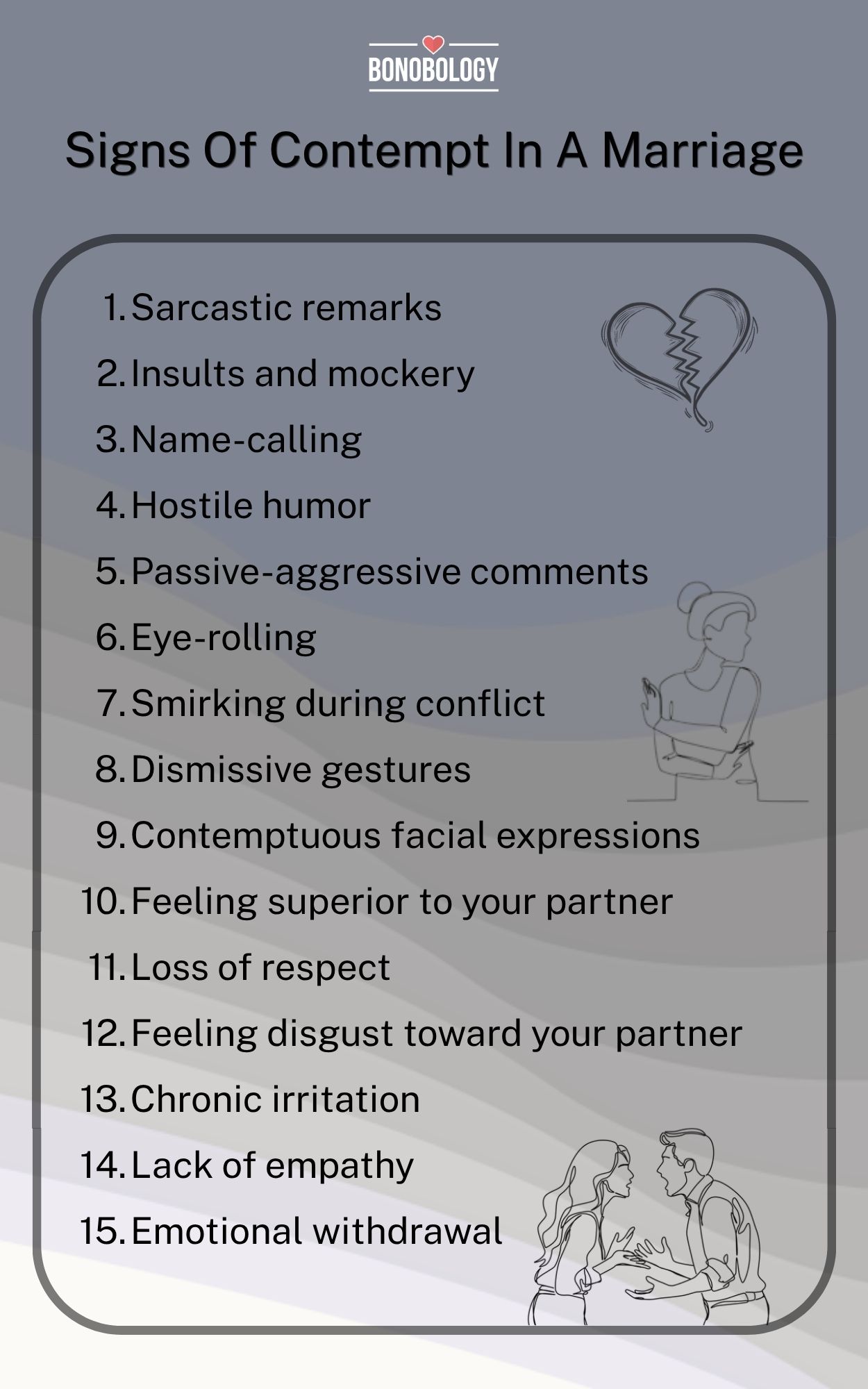
Signs Of Contempt In A Marriage
Recognizing contempt is the first step to stopping it. In many cases, contempt in a marriage doesn’t arrive loudly. It shows up slowly, through tone, expressions, and small moments that slowly chip away at respect. Over time, these patterns create achar mothúchánach in marriage and begin to feel normal, even though they are deeply harmful.
Verbal signs
The most obvious signs of contempt in marriage show up in language. These are not simple disagreements. They reflect contemptuous behavior that attacks your partner’s identity.
1. Sarcastic remarks
Comments like “Great job, genius” or “Of course you messed it up again” may sound casual, but the mocking tone carries emotional contempt. Sarcasm often hides deeper resentment and emotional invalidation.
2. Insults and mockery
Making fun of your partner’s habits, opinions, or abilities creates a pattern of relational aggression. Even when disguised as humor, it signals disrespect in marriage.
Léitheoireacht Ghaolmhar: 25 Ceacht Pósta a D'fhoghlaimíomar inár gCéad Bhliain Pósta
3. Name-calling in marriage
Words like “idiot,” “useless,” or “pathetic” go beyond frustration. They attack self-worth and contribute to the easpa measa i gcaidreamh.
4. Hostile humor and verbal put-downs
Jokes that belittle your spouse may seem harmless in the moment, but repeated over time, they form toxic communication patterns.
5. Passive-aggressive comments
Moltaí ar ais like “Wow, you actually did something right today” reflect underlying contempt in relationships. These remarks often come from suppressed anger rather than honest communication.
Non-verbal signs
Words are not the only thing that stings. Contempt often shows up without a single sentence. Body language becomes the carrier of meaning, and it is usually more damaging because it feels instinctive and hard to argue with.
1. Eye-rolling in arguments
One of the most studied signs of contempt in a marriage. It communicates dismissal, as if your partner’s thoughts are not even worth engaging with.

2. Smirking during conflict
That slight half-smile, often unnoticed, signals feeling superior in a relationship. It says, “I’m above this.”
3. Dismissive gestures
Turning away, checking your phone, sighing loudly, or covering your face while your partner speaks all indicate díorma mhothúchánach.
4. Contemptuous facial expressions
A subtle look of disgust, raised eyebrows, or a sideways smile can express more than harsh words ever could.
Léitheoireacht ghaolmhara: 4 Chéim den Chrios Cogaidh ar a dtugtar Pósadh
Psychological signs
The deepest signs of contempt in marriage are internal. They shape how you think about your partner, often without you realizing it.
1. Feeling superior in a relationship
You begin to believe you are more responsible, more intelligent, or more emotionally aware than your partner. This mindset fuels contempt and marriage breakdown patterns.
2. Loss of respect in a relationship
You stop admiring your partner. Even their strengths become invisible. You may struggle to recall what you once appreciated about them.
Léitheoireacht ghaolmhara: 12 Tréithe Pósta Rathúil
3. Feeling disgust toward partner
This goes beyond anger. It is a deeper emotional rejection, almost like revulsion. This is the core of emotional contempt.
4. Chronic irritation
Small things begin to feel unbearable. The way they talk, eat, or respond starts to annoy you disproportionately. This is often a sign of unresolved resentment.
5. Easpa comhbhá
You stop caring about how your partner feels. Their struggles seem self-inflicted, and their emotions feel inconvenient rather than important.
6. Tarraingt siar mhothúchánach
Tá tú check out emotionally. Conversations become mechanical. Physical intimacy fades. You may still be present physically, but emotionally, you are distant.
What Causes Contempt In Marriage?
Contempt in a marriage rarely begins with one big event. It builds slowly. Small disappointments, repeated misunderstandings, and unspoken expectations start to pile up. Over time, these experiences shape how you see your partner. What once felt like connection begins to feel like distance. Here are the most common root causes.
1. Unresolved resentment
When one partner feels wronged or hurt by something, either big or small, and never really talks about it, that resentment slowly turns into contempt. For example, if you feel your partner consistently rejects your needs or glacann sé leat, and you don’t address it, frustration builds until you start seeing them in a negative light.
“When you don’t communicate to your spouse that you are annoyed by XYZ, your spouse will continue to do XYZ. You will begin to resent your spouse for doing XYZ because you’re annoyed by it….eventually that resentment festers into contempt and you can’t disassociate your spouse from XYZ”
- Úsáideoir Reddit
2. Feeling unappreciated
When you feel your efforts go unnoticed or undervalued, you may develop a superiority complex as a defense. Similarly, when you stop noticing your partner’s good deeds or intentions, negative narratives take over.
Léitheoireacht ghaolmhara: Ar Phósadh Agus Comh-Mhaireachtáil Shona Le Do Pháirtí
3. Chronic criticism
Constant complaints or criticism can snowball into contempt.
- If you habitually criticize your partner’s habits or personality, it sets a pattern
- Over time, what might start as a complaint can become contemptuous attacks
Chronic criticism tells your partner they can never meet your standards, planting the seeds of contempt.
4. Dearmad mhothúchánach
Contempt can easily sneak in if you or your partner emotionally withdraw due to:
- Strus
- Storm
- Or simply growing apart
Easpa dlúthpháirtíochta and connection makes it easy to devalue the other person. When you don’t share feelings or make the other feel important, you start taking each other for granted. This can leave both feeling resentful or even hostile over time.

5. Negative narrative about partner
Sometimes contempt comes from telling yourself a twisted story about your spouse. You might say in your head:
- “I’m the only responsible one”
- Or “They do everything wrong”
- Or “I’m doing all the work”
These cognitive distortions – and yes, they are just distortions – feed contempt. Once you’ve labeled your spouse as lazy, selfish, or stupid, it’s easy to treat them accordingly.
6. Éagothroime cumhachta
If one partner consistently feels powerless or unheard, contempt can form as a way to regain a sense of power. Conversely, the person in control may start to look down on the other. Over time, resentment over the streachailt cumhachta turns into contempt.
How To Fix Contempt In A Marriage
Repairing contempt in a marriage is not quick work. It asks for awareness, honesty, and a willingness to shift patterns that may have been in place for years. But it is possible. Many couples move from emotional contempt back to connection when they actively choose to rebuild respect. Here are steps that actually help.
1. Build a culture of appreciation and respect
Start noticing the good. Deliberately focus on your partner’s positive qualities and efforts. Gottman suggests tiny moments of gratitude:
- Thanking them for small things
- Acknowledging when they help
- And regularly expressing what you admire about them
- Writing little nótaí grá or sending kind texts
The goal is to flood your relationship with positives that counteract contempt.
Léitheoireacht ghaolmhara: Cén Fáth a Bhfuil Pósadh Chomh Crua? Fáthanna agus Bealaí Chun É a Dhéanamh Fiúntais
2. Address resentment directly
Contempt is usually fueled by buried grievances. It’s critical to talk about what’s really bothering you in a calm way.
- Use gentle start-up statements instead of accusations. For example, instead of “You never listen to me,” try, “I feel hurt and unheard when I talk and my concerns seem dismissed”
- Avoid “you” accusations, which trigger defensiveness
This opens up dialogue instead of a fight. Both partners should have a chance to share their resentments and work toward solutions, with patience and empathy.
Léitheoireacht ghaolmhara: 12 Rud a Dhéanann Mná a Scriosann Póstaí
3. Úsáid ráitis “I”.
Along the same lines, frame concerns from your perspective. Saying “I feel so lonely when we don’t spend am cáilíochta together” is far more constructive than “You never want to be with me.” “I” statements reduce blame and show you’re taking ownership of your feelings. This technique actively undermines the contempt mindset.
4. Rebuild respect
Make a conscious effort to treat each other with the basic courtesy you started with.
- Listen fully when your spouse speaks, even if you disagree
- Avoid interrupting or talking over them
- Remember to offer bailíochtú mhothúchánach
You might even explicitly say, “I respect your opinion, even when it’s different from mine.” Recalling and sharing what you first admired about your partner can reignite compassion.
Léitheoireacht Ghaolmhar: Airgead Agus Pósadh – Leideanna le haghaidh Pósadh Rathúil ó thaobh Airgeadais de
5. Seek therapy or counseling
Sometimes patterns of contempt are deep-rooted, especially if they echo past family or trauma issues. A skilled therapist can give you tools to break these patterns. A counselor can also help you build empathy and teach concrete skills to communicate without hostility. In other words, therapy provides an evidence-based approach to heal contempt.
Bonobology offers access to an array of professional therapists and counselors that can guide on how to revive your marriage. Cuir seisiún in áirithe inniu!
6. Gabh mo leithscéal agus logh
If you’ve expressed contempt, own it.
- Say a sincere sorry for hurtful words or gestures and explain you’re working on changing
- Likewise, try to genuinely forgive your partner’s moments of contempt when they apologize
Holding onto past insults only fuels more resentment.

How To Prevent Contempt In The Future
Once you’ve quelled contempt, you’ll want to keep it from creeping back. Preventing contempt is about fostering ongoing positivity and repair. Here are some strategies:
- Regular emotional check-ins: Make it a routine to ask each other, “How are you feeling about us lately?” or “Is there anything bothering you?” This keeps grievances from simmering
- Appreciation rituals: Set up habits like sharing one thing you appreciated about your spouse each day, or leaving them a quick love note. These small gothaí rómánsúla build a buffer of goodwill
- Conflict repair skills: Learn to fight fair. Use time-outs if arguments get heated: agree to pause and come back after cooling off
- Keep dating and having fun: Remember that you chose each other for good reasons. Continue doing things you both enjoy, laugh together, and be affectionate. Fun and friendship inject positive sentiment into your relationship
- Maintain empathy: Whenever you get upset, pause and consider what might be stressing your partner. Are they tired, worried about work, in pain? Stress in one area of life can sometimes spill over

Cathain a Iarrtar Cabhair Ghairmiúil
Not every situation of contempt in a marriage can be repaired through self-awareness and effort alone. Sometimes, the patterns are too deep, too repetitive, or too emotionally charged. In such cases, outside support becomes necessary to pósadh a shábháil.
- Contempt is chronic and escalating: If small snarks have become routine attacks, or arguments always end in insults
- Tarraingt siar mhothúchánach: If one or both of you have “checked out;” you no longer share feelings, sex has stopped, or you live like roommates
- Persistent disrespect: If boundaries have been crossed, for example, name-calling, public humiliation) and trust is broken
- You feel unsafe or depressed: Contempt can lead to verbal abuse. If you or your partner feel scared, depressed, or physically threatened, get help immediately
- You’ve tried and nothing’s changing: If you’ve made efforts and the contempt continues, a professional can guide you more effectively
Ceisteanna Coitianta
Contempt often looks like disrespect and disdain. You might hear sarcasm, hostile jokes, name-calling, or mockery between spouses. Non-verbally, it can be eye-rolling, sneering, or dismissive gestures. Psychologically, it feels like one partner acting superior and the other feeling worthless.
Because contempt destroys the respect and emotional safety a marriage needs. When you treat your partner with contempt, literally as if they are inferior or disgusting, it erodes love and trust.
Yes, it can be reversed, but it takes work from both partners. The first step is awareness – noticing and admitting contempt is happening. Then, couples must actively replace contempt with its opposite: respect and appreciation.
Príomhthreoir
- In marriage, contempt means looking down on your spouse and thinking you’re better than them
- Contempt often grows from long-held resentment, unmet needs, or negative thinking patterns
- Common signs of contempt include sarcastic remarks, mocking tone, eye-rolling, dismissive gestures, and verbal put-downs
- The antidote is building appreciation and positive sentiment
Smaointe Deiridh
Contempt in a marriage is a serious issue, but it is addressable. Imagine if you replaced “I’m better than you” with “I care about you”. The smallest acts of kindness can be more powerful than grand gestures. Remember, “the opposite of contempt is not love – it’s respect.” Treat your partner as your equal, and you can keep contempt from taking hold. It might take time and honesty, but with genuine effort, you can rebuild a relationship grounded in respect and mutual understanding.
Conas a Oibríonn Comhairliúchán Pósta chun Saincheisteanna Caidrimh a Réiteach?
Conas Pósadh a Shábháil Nuair Níl ach Duine Amháin Ag Iarraidh?
15 Chomhartha Go Bhfuil Do Phósadh Ar na Carraigeacha agus Beagnach Deireadh
Ní hionann do ranníocaíocht agus síntiús carthanachta . Cuirfidh sé ar chumas Bonobology leanúint ar aghaidh ag tabhairt faisnéise nua agus cothrom le dáta duit agus muid ag iarraidh cabhrú le duine ar bith ar domhan foghlaim conas aon rud a dhéanamh.













Réadmhaoin
31 Comharthaí Cruálach Nach bhfuil Grá ag Do Bhean Chéile Duit A Mheá
Pósta Ach Ag Breathnú Do Dhuine Le Labhairt Leat? Míníonn Teiripeoir Cad atá Le Déanamh
Cén Fáth A Bhfuil Mise Múchta Mar sin Ag Mo Fhear céile - 10 bhFáthanna Agus Leideanna le Seachaint
21 Comharthaí Tá Ceisteanna Feirge ag Do Fear Agus Conas Déileáil Leat
15 Chomhartha Buarthacha Nach bhFuil Do Fear céile Tarraingteach thú Agus 5 Bhealaí Chun É a Láimhseáil
17 Comharthaí Dortacha Nach bhfuil Grá ag D'fhear céile ort a thuilleadh
11 Rud a Tharlaíonn Nuair a Chailleann Bean Suim ina Fear céile
11 Comharthaí Go bhfuil Tú Pósta go Míshásta Agus i nGrá Le Duine Eile
Is fuath le mo Bhanchéile mé: 5 Chomhartha, 8 Cúiseanna Féideartha, Agus 9 Leid Le Déileáil
Intimacy Anorexia, Cúiseanna, Agus Tionchar Ar Chaidrimh Rómánsacha - Agus Bealaí Le Déileáil Leis
Is fuath liom mo fhear céile - 10 gcúiseanna féideartha agus cad is féidir leat a dhéanamh faoi
12 Comhartha Briste Croí Tá do Phósadh thart
9 Iarmhairtí Fanacht I bPósadh Míshásta
Conas a Láimhseálann Fear céile Nach bhfuil Meas ar bith Agat Féin nó Do Mhothúcháin
17 Comhartha Ní Féidir Pósadh a Shábháil
7 Rudaí Le Déanamh Nuair a Thitfidh Tú As Grá Le Do Fhear céile
13 Chomhartha a Sheiceáil Do Bhean chéile As an bPósadh
9 Céimeanna Pósta ag fáil bháis
13 Chomhartha Snátha Ní Mhealltar Do Bhean Chéile A Dhéanamh A Dhéanamh Níos Mó - Agus 5 Rud Is Féidir Leat a Dhéanamh
14 Comharthaí Tá sé beartaithe ag d'fhear céile Tú a Fháil