

Le mépris au sein d'un mariage va bien au-delà de la simple colère ou du désaccord ; il s'agit d'un sentiment de supériorité, d'un manque de respect, voire d'un dégoût émotionnel envers son conjoint. De fait, des chercheurs comme le Dr John Gottman ont constaté que le mépris est le facteur prédictif le plus important du divorce, plus encore que l'infidélité ou les conflits financiers.
Lorsqu'un partenaire traite l'autre avec mépris ou un sarcasme moqueur, cela envoie un message clair de dégoût et de supériorité morale.
Plats à emporter
Le mépris au sein du mariage se caractérise par un manque de respect, une attitude de supériorité et une distance émotionnelle. Il se manifeste par le sarcasme, les insultes, les regards désapprobateurs et un comportement dédaigneux. Selon John Gottman, il s'agit du facteur prédictif le plus important du divorce, car il détruit le respect et la sécurité affective.
Ce problème résulte généralement de ressentiments non résolus et d'une mauvaise communication. Heureusement, il est possible d'y remédier en rétablissant le respect mutuel, en améliorant la communication et en s'attaquant rapidement aux problèmes sous-jacents.
Qu'est-ce que le mépris dans un mariage ?
Table des Matières
Le mépris au sein du mariage consiste à traiter son partenaire comme un inférieur, une attaque personnelle contre sa valeur ou son caractère, et non pas simplement à exprimer sa frustration face à un acte commis. Contrairement à la critique habituelle, qui vise un comportement précis, le mépris s'attaque à l'identité même du conjoint. Il découle souvent d'une colère ou d' un ressentiment latent au sein du couple et se manifeste par des signes, ouverts ou subtils, laissant entendre que le conjoint est, d'une manière ou d'une autre, inférieur.
Par exemple, le mépris peut se manifester ainsi :
- Se moquer des idées de son partenaire
- Sarcasme
- Ou en les insultant
Il peut aussi être silencieux :
- Un haussement d'épaules
- Un sourire narquois
- Ou un geste de dédain
Avec le temps, le mépris envoie le message « Je suis meilleur que toi », ce qui détruit le sentiment de sécurité et d'égalité dont les relations ont besoin.
Pourquoi le mépris est si dangereux
Le mépris est souvent qualifié de « tueur silencieux » des relations, et à juste titre. Il ne se contente pas de blesser sur le moment, il érode les fondements mêmes du mariage. Le respect et l'admiration mutuels sont le ciment d'une union, et le mépris le brise. On finit par ne plus voir son conjoint que comme un problème ou un fardeau, et non plus comme un allié ou un être cher.
Voici ce qui se passe lorsque le mépris s'installe :
- Détruit le respect : Le mépris exprime le manque de respect. Avec le temps, on cesse d'accorder de l'importance aux opinions et aux efforts de l'autre. Le conjoint se sent méprisé et inutile.
- Crée de la distance Cela crée un fossé émotionnel. Vous pourriez commencer à vous éviter ou à ne vous parler que pour vous disputer.
- Déclenche une attitude défensive : Lorsque vous rabaissez votre partenaire, il se met souvent sur la défensive ou arrêterCela rend impossible la résolution même des petits conflits.
- Érode la sécurité émotionnelle : Un mariage s'épanouit lorsque chacun se sent en sécurité pour exprimer ses besoins et ses vulnérabilités. Le mépris fait voler en éclats cette barrière de sécurité.
- Nuisible à la santé : Étonnamment, études Les couples qui se témoignent régulièrement du mépris souffrent davantage de maladies physiques que les couples plus heureux. Le stress et les blessures émotionnelles affaiblissent littéralement le système immunitaire.
Lecture complémentaire : 7 principes fondamentaux de l’engagement dans le mariage
Signes de mépris dans un mariage
Reconnaître le mépris est la première étape pour y mettre fin. Bien souvent, le mépris au sein du couple ne se manifeste pas bruyamment. Il s'installe insidieusement, par le ton employé, les expressions et de petits gestes qui, petit à petit, érodent le respect. Avec le temps, ces comportements créent une distance émotionnelle et finissent par paraître normaux, même s'ils sont profondément néfastes.
Signes verbaux
Les signes les plus évidents de mépris dans le mariage se manifestent dans les mots. Il ne s'agit pas de simples désaccords, mais d'un comportement méprisant qui s'attaque à l'identité du partenaire.
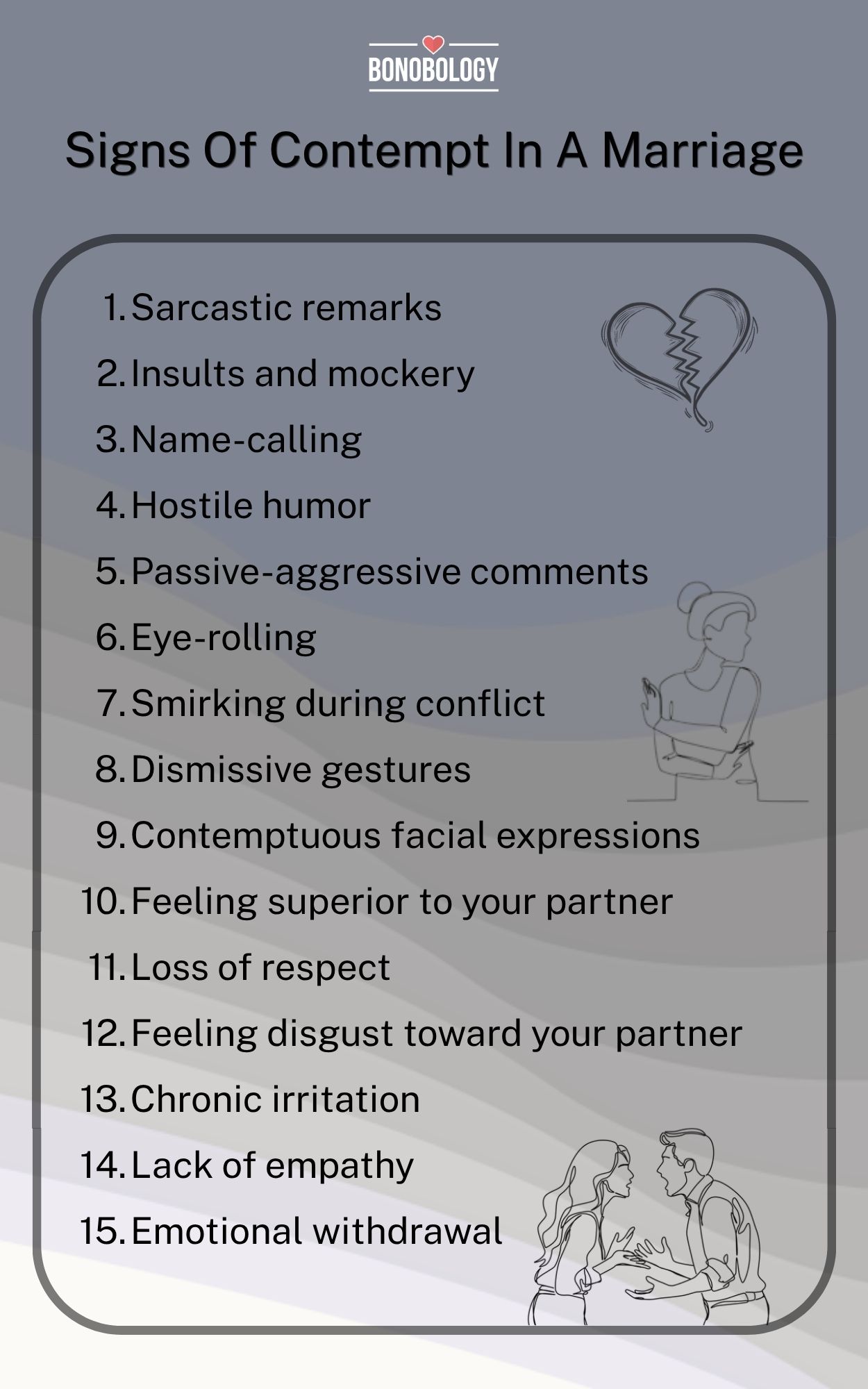
1. Remarques sarcastiques
Des commentaires comme « Bravo, génie ! » ou « Bien sûr, tu as encore tout gâché ! » peuvent paraître anodins, mais le ton moqueur cache un profond mépris. Le sarcasme dissimule souvent un ressentiment plus profond et une invisibilisation émotionnelle.
2. Insultes et moqueries
Se moquer des habitudes, des opinions ou des capacités de son partenaire instaure un climat d'agression relationnelle. Même sous couvert d'humour, cela témoigne d'un manque de respect au sein du mariage.
Lectures complémentaires : 25 leçons de mariage apprises durant notre première année de mariage
3. Les insultes dans le mariage
Des mots comme « idiot », « inutile » ou « pathétique » vont au-delà de la simple frustration. Ils s'attaquent à l'estime de soi et contribuent au manque de respect dans une relation.
4. Humour hostile et remarques désobligeantes
Les blagues qui rabaissent votre conjoint peuvent sembler inoffensives sur le moment, mais répétées au fil du temps, elles créent des schémas de communication toxiques.
5. Commentaires passifs-agressifs
Les compliments ambigus comme « Waouh, tu as vraiment fait quelque chose de bien aujourd'hui » révèlent un mépris sous-jacent dans les relations. Ces remarques proviennent souvent d'une colère refoulée plutôt que d'une communication sincère.
Signes non verbaux
Les mots ne sont pas les seuls à blesser. Le mépris se manifeste souvent sans un mot. Le langage corporel devient alors porteur de sens, et il est généralement plus destructeur car instinctif et difficile à contrer.
1. Lever les yeux au ciel pendant les disputes
L'un des signes de mépris les plus étudiés au sein du couple. Il traduit le dédain, comme si les pensées de votre partenaire ne méritaient même pas qu'on s'y attarde.

2. Sourire en coin pendant un conflit
Ce léger demi-sourire, souvent imperceptible, traduit un sentiment de supériorité dans une relation. Il signifie : « Je suis au-dessus de ça. »
3. Gestes de dédain
Se détourner, consulter son téléphone, soupirer bruyamment ou se couvrir le visage pendant que son partenaire parle sont autant de signes de détachement émotionnel.
4. Expressions faciales méprisantes
Un léger regard de dégoût, des sourcils levés ou un sourire en coin peuvent exprimer bien plus que des mots durs.
Lecture complémentaire : Les 4 étapes de la zone de guerre appelée mariage
Signes psychologiques
Les signes les plus profonds de mépris dans le mariage sont intérieurs. Ils façonnent la façon dont vous pensez à votre partenaire, souvent sans que vous vous en rendiez compte.
1. Se sentir supérieur dans une relation
Vous commencez à croire que vous êtes plus responsable, plus intelligent ou plus sensible aux émotions que votre partenaire. Cet état d'esprit alimente le mépris et les mécanismes de rupture conjugale.
2. Perte de respect dans une relation
Vous cessez d'admirer votre partenaire. Même ses qualités vous échappent. Vous avez peut-être du mal à vous rappeler ce que vous appréciiez chez lui ou elle.
Lecture complémentaire : 12 caractéristiques d’un mariage réussi
3. Éprouver du dégoût envers son/sa partenaire
Cela va au-delà de la colère. Il s'agit d'un rejet émotionnel plus profond, presque de la répulsion. C'est le cœur même du mépris émotionnel.
4. Irritation chronique
Les petites choses deviennent insupportables. Leur façon de parler, de manger ou de réagir commence à vous agacer de façon disproportionnée. C'est souvent le signe d'un ressentiment non résolu.
5. Manque d'empathie
Vous cessez de vous soucier des sentiments de votre partenaire. Ses difficultés vous semblent de sa propre faute, et ses émotions vous paraissent gênantes plutôt qu'importantes.
6. Retrait émotionnel
Vous vous déconnectez émotionnellement . Les conversations deviennent mécaniques. L'intimité physique s'estompe. Vous êtes peut-être toujours présent physiquement, mais émotionnellement, vous êtes distant.
Qu’est-ce qui provoque le mépris dans le mariage ?
Le mépris au sein d'un couple naît rarement d'un événement majeur. Il s'installe progressivement. Petites déceptions, malentendus répétés et attentes non exprimées s'accumulent. Avec le temps, ces expériences modifient votre perception de votre partenaire. Ce qui ressemblait autrefois à de la complicité se transforme en distance. Voici les causes profondes les plus fréquentes.
1. Ressentiment non résolu
Lorsqu'un partenaire se sent lésé ou blessé par quelque chose, d'important ou de anodin, et n'en parle jamais vraiment, ce ressentiment se transforme peu à peu en mépris. Par exemple, si vous avez l'impression que votre partenaire ignore constamment vos besoins ou vous considère comme acquis , et que vous n'en parlez pas, la frustration monte jusqu'à ce que vous commenciez à le/la percevoir d'un œil négatif.
« Si vous n'exprimez pas à votre conjoint votre agacement face à XYZ, il continuera à faire XYZ. Vous commencerez alors à lui en vouloir, car cela vous agace… et finalement, ce ressentiment se transformera en mépris, et vous ne pourrez plus dissocier votre conjoint de XYZ. »
- Utilisateur Reddit
2. Se sentir dévalorisé
Lorsque vous avez l'impression que vos efforts passent inaperçus ou sont sous-estimés, vous pouvez développer un complexe de supériorité comme mécanisme de défense. De même, lorsque vous cessez de remarquer les bonnes actions ou les bonnes intentions de votre partenaire, des pensées négatives prennent le dessus.
Lectures complémentaires : Sur le mariage et la coexistence harmonieuse avec son/sa partenaire
3. Critique chronique
Les plaintes ou les critiques incessantes peuvent se transformer en mépris.
- Si vous critiquez systématiquement les habitudes ou la personnalité de votre partenaire, cela crée un schéma.
- Avec le temps, ce qui peut commencer comme une plainte peut se transformer en attaques méprisantes.
Les critiques chroniques laissent entendre à votre partenaire qu'il ou elle ne pourra jamais être à la hauteur de vos exigences, semant ainsi les graines du mépris.
4. Négligence émotionnelle
Le mépris peut facilement s'insinuer si vous ou votre partenaire vous retirez émotionnellement à cause de :
- Stress
- Dépression
- Ou tout simplement s'éloigner les uns des autres
Le manque d'intimité et de connexion favorise la dévalorisation de l'autre. Lorsqu'on ne partage pas ses sentiments ou qu'on ne fait pas sentir à l'autre son importance, on finit par considérer l'autre comme acquis. Cela peut engendrer, à terme, du ressentiment, voire de l'hostilité, chez les deux partenaires.

5. Récit négatif concernant le/la partenaire
Parfois, le mépris naît d'une histoire déformée que l'on se raconte sur son conjoint. On pourrait se dire :
- « Je suis le seul responsable. »
- Ou encore : « Ils font tout de travers ».
- Ou « Je fais tout le travail »
Ces distorsions cognitives – et oui, ce ne sont que des distorsions – alimentent le mépris. Une fois que vous avez étiqueté votre conjoint comme paresseux, égoïste ou stupide, il est facile de le traiter en conséquence.
6. Déséquilibres de pouvoir
Si l'un des partenaires se sent constamment impuissant ou ignoré, le mépris peut s'installer comme moyen de reprendre le contrôle. Inversement, la personne qui domine peut commencer à mépriser l'autre. Avec le temps, le ressentiment lié à cette lutte de pouvoir se transforme en mépris.
Comment remédier au mépris dans un mariage
Réparer le mépris au sein d'un couple est un travail de longue haleine. Cela exige de la prise de conscience, de l'honnêteté et la volonté de modifier des schémas relationnels parfois ancrés depuis des années. Mais c'est possible. De nombreux couples parviennent à renouer avec la complicité en choisissant activement de reconstruire le respect mutuel. Voici quelques pistes concrètes.
1. Développer une culture de reconnaissance et de respect
Commencez par remarquer le positif. Concentrez-vous délibérément sur les qualités et les efforts de votre partenaire. Gottman suggère de savourer de petits moments de gratitude :
- Les remercier pour les petites choses
- Reconnaître leur aide
- Et en exprimant régulièrement ce que vous admirez chez eux
- Écrire peu notes d'amour ou en envoyant des messages gentils
L'objectif est d'inonder votre relation d'éléments positifs qui contrebalancent le mépris.
Lectures complémentaires : Pourquoi le mariage est-il si difficile ? Raisons et moyens de le rendre plus épanouissant
2. Abordez directement le ressentiment.
Le mépris est souvent alimenté par des griefs refoulés. Il est essentiel de parler calmement de ce qui vous préoccupe réellement.
- Privilégiez les phrases d'accroche douces aux accusations. Par exemple, au lieu de dire « Tu ne m'écoutes jamais », essayez plutôt : « Je me sens blessé(e) et incompris(e) quand je parle et que mes préoccupations semblent ignorées. »
- Évitez les accusations commençant par « tu », qui déclenchent une attitude défensive.
Cela ouvre la voie au dialogue plutôt qu'à la confrontation. Les deux partenaires devraient avoir l'occasion d'exprimer leurs ressentiments et de travailler ensemble à la recherche de solutions, avec patience et empathie.
Lectures complémentaires : 12 choses que font les femmes et qui détruisent les mariages
3. Utilisez des déclarations en « je »
Dans le même esprit, exprimez vos préoccupations de votre point de vue. Dire « Je me sens si seul(e) quand on ne passe pas de bons moments ensemble » est bien plus constructif que « Tu ne veux jamais être avec moi ». Utiliser le « je » permet de réduire la culpabilité et montre que vous assumez vos sentiments. Cette technique contribue à déconstruire la mentalité de mépris.
4. Reconstruire le respect
Efforcez-vous de vous traiter les uns les autres avec la même courtoisie élémentaire qu'au début.
- Écoutez attentivement votre conjoint lorsqu'il parle, même si vous n'êtes pas d'accord.
- Évitez de les interrompre ou de parler par-dessus eux.
- N'oubliez pas de proposer validation émotionnelle
Vous pourriez même dire explicitement : « Je respecte ton opinion, même si elle diffère de la mienne. » Se remémorer et partager ce que vous avez admiré chez votre partenaire au début peut raviver la compassion.
Lectures complémentaires : Argent et mariage – Conseils pour un mariage financièrement réussi
5. Demandez une thérapie ou un accompagnement psychologique
Parfois, les schémas de mépris sont profondément ancrés, surtout s'ils font écho à des problèmes familiaux ou à des traumatismes passés. Un thérapeute compétent peut vous donner les outils nécessaires pour briser ces schémas. Il peut également vous aider à développer votre empathie et vous enseigner des techniques concrètes pour communiquer sans hostilité. En d'autres termes, la thérapie offre une approche éprouvée pour guérir le mépris.
Bonobology vous donne accès à un large éventail de thérapeutes et de conseillers professionnels qui peuvent vous guider pour raviver votre mariage. Prenez rendez-vous dès aujourd'hui !
6. Présentez vos excuses et pardonnez
Si vous avez exprimé du mépris, assumez-le.
- Présentez des excuses sincères pour les paroles ou gestes blessants et expliquez que vous travaillez à changer.
- De même, essayez de pardonner sincèrement les moments de mépris de votre partenaire lorsqu'il s'excuse.
Le fait de ressasser les insultes passées ne fait qu'alimenter le ressentiment.

Comment prévenir le mépris à l'avenir
Une fois le mépris apaisé, il est important d'éviter qu'il ne réapparaisse. Prévenir le mépris, c'est cultiver une attitude positive et favoriser la réparation des liens. Voici quelques stratégies :
- Bilans émotionnels réguliers : Prenez l'habitude de vous demander mutuellement : « Comment te sens-tu par rapport à nous ces derniers temps ? » ou « Y a-t-il quelque chose qui te tracasse ? » Cela évitera que les griefs ne s'enveniment.
- Rituels d'appréciation : Instaurez des habitudes comme partager chaque jour une chose que vous appréciez chez votre conjoint(e), ou lui laisser un petit mot doux. Ces petites attentions gestes romantiques constituer une réserve de bonne volonté
- Compétences en résolution de conflits : Apprenez à vous disputer de manière constructive. Utilisez des pauses si les discussions s'enveniment : convenez d'une pause et de reprendre la discussion après vous être calmés.
- Continuez à sortir ensemble et à vous amuser : N'oubliez pas que vous vous êtes choisis pour de bonnes raisons. Continuez à faire des choses que vous aimez tous les deux, à rire ensemble et à vous témoigner de l'affection. Le plaisir et l'amitié insufflent une ambiance positive à votre relation.
- Faites preuve d'empathie : Lorsque vous êtes contrarié(e), prenez un instant pour réfléchir à ce qui pourrait stresser votre partenaire. Est-il/elle fatigué(e), inquiet(ète) pour son travail, souffre-t-il/elle ? Le stress dans un domaine de la vie peut parfois avoir des répercussions sur l’ensemble de l’environnement de votre partenaire.

Quand demander de l'aide professionnelle
Toutes les situations de mépris au sein d'un mariage ne peuvent être résolues par la seule prise de conscience et les efforts personnels. Parfois, les schémas relationnels sont trop profondément ancrés, trop répétitifs ou trop chargés émotionnellement. Dans de tels cas, un soutien extérieur devient nécessaire pour sauver le mariage.
- Le mépris est chronique et croissant : Si les petites piques sont devenues des attaques habituelles, ou si les disputes se terminent toujours par des insultes
- Retrait émotionnel : Si l'un de vous deux, ou les deux, avez « décroché », vous ne partagez plus vos sentiments, les relations sexuelles ont cessé, ou vous vivez comme des colocataires.
- Manque de respect persistant : Si les limites ont été franchies (par exemple, insultes, humiliations publiques) et que la confiance est rompue, la confiance est rompue.
- Vous vous sentez en danger ou déprimé(e) : Le mépris peut mener à des violences verbales. Si vous ou votre partenaire vous sentez effrayés, déprimés ou physiquement menacés, demandez de l'aide immédiatement.
- Vous avez essayé et rien ne change : Si vous avez fait des efforts et que le mépris persiste, un professionnel pourra vous guider plus efficacement.
FAQ
Le mépris se manifeste souvent par l'irrespect et le dédain. Il peut se traduire par du sarcasme, des plaisanteries acerbes, des insultes ou des moqueries entre conjoints. De manière non verbale, il peut s'agir de regards désapprobateurs, de ricanements ou de gestes dédaigneux. Psychologiquement, l'un des partenaires se sent supérieur tandis que l'autre se sent insignifiant.
Car le mépris détruit le respect et la sécurité affective indispensables au mariage. Traiter son partenaire avec mépris, comme s'il était inférieur ou répugnant, érode l'amour et la confiance.
Oui, c'est possible d'y remédier, mais cela demande des efforts de la part des deux partenaires. La première étape est la prise de conscience : remarquer et admettre que le mépris est présent. Ensuite, les couples doivent activement remplacer le mépris par son contraire : le respect et la reconnaissance.
Pointeurs clés
- Dans le mariage, le mépris signifie regarder son conjoint de haut et se croire supérieur à lui.
- Le mépris naît souvent d'un ressentiment tenace, de besoins non satisfaits ou de schémas de pensée négatifs.
- Les signes courants de mépris incluent les remarques sarcastiques, le ton moqueur, les yeux levés au ciel, les gestes dédaigneux et les insultes.
- L'antidote consiste à développer l'appréciation et un sentiment positif
Réflexions finales
Le mépris au sein d'un couple est un problème grave, mais il est possible d'y remédier. Imaginez si vous remplaciez « Je suis meilleur que toi » par « Je tiens à toi ». Les plus petites attentions peuvent être plus puissantes que les grands gestes. N'oubliez pas : « Le contraire du mépris n'est pas l'amour, c'est le respect. » Traitez votre partenaire comme votre égal, et vous empêcherez le mépris de s'installer. Cela demandera peut-être du temps et de la sincérité, mais avec un effort sincère, vous pouvez reconstruire une relation fondée sur le respect et la compréhension mutuelle.
Comment le conseil conjugal fonctionne-t-il pour résoudre les problèmes relationnels ?
Votre contribution ne constitue pas un don caritatif . Elle permettra à Bonobology de continuer à vous fournir des informations nouvelles et actualisées, dans le but d'aider chacun, partout dans le monde, à apprendre à faire n'importe quoi.



















En vedette
31 signes cruels que votre femme ne vous aime plus
Marié(e) mais à la recherche d'un interlocuteur ? Un thérapeute vous explique comment procéder.
Pourquoi mon mari me rebute-t-il autant ? Dix raisons et conseils pour l'éviter
21 signes indiquant que votre homme a des problèmes de colère et comment y faire face
15 signes inquiétants indiquant que votre mari ne vous trouve pas attirante et 5 façons d'y faire face
17 signes angoissants que votre mari ne vous aime plus
11 choses qui arrivent lorsqu'une femme perd tout intérêt pour son mari
11 signes que vous êtes malheureux en mariage et amoureux de quelqu'un d'autre
Ma femme me déteste : 5 signes, 8 raisons possibles et 9 conseils pour y faire face
Anorexie intime, causes et impact sur les relations amoureuses – et solutions pour y faire face
Je déteste mon mari : 10 raisons possibles et ce que vous pouvez faire à ce sujet
12 signes déchirants que votre mariage est terminé
9 conséquences d'un mariage malheureux
Comment gérer un mari qui n'a aucun respect pour vous ou vos sentiments
17 signes qu'un mariage ne peut pas être sauvé
7 choses à faire lorsque vous tombez amoureux de votre mari
13 signes que votre femme a quitté le mariage
Les 9 étapes d'un mariage en fin de vie
13 signes subtils que votre femme n'est plus attirée par vous - Et 5 choses que vous pouvez faire
14 signes que votre mari envisage de vous quitter