

Imago Therapy, also known as Imago Relationship Therapy, is a specialized couples counseling approach designed to help you and your partner communicate better and heal underlying emotional wounds. The word “imago” is Latin for “image,” referring to the unconscious image of love that each person carries from childhood. In Imago Therapy, you explore how your childhood experiences shape adult relationships, often in ways you might not realize. This therapy was co-created by Harville Hendrix and Helen LaKelly Hunt in the 1980s to address why couples fall into conflict and how those conflicts can actually become opportunities for growth and healing.
Why does Imago Therapy matter? Because it tackles the root of so many relationship struggles. If you and your partner find yourselves having the same argument over and over, feeling disconnected, or unable to truly understand each other’s needs, Imago Therapy offers a structured communication framework to break those cycles. It focuses on uncovering the deeper unconscious needs and old wounds driving your conflicts. By doing so, couples can transform tension into insight and compassion. In short, Imago couples therapy focuses on turning conflict into a pathway for empathy and emotional connection in relationships.
Quick Takeaways
- Imago Relationship Therapy is a form of couples counseling that helps partners improve communication and understand each other by uncovering how childhood experiences shape adult relationships
- It was developed by Harville Hendrix and Helen LaKelly Hunt in the 1980s. They introduced the concept of the “imago”, an unconscious image of love formed from early caregivers, which influences whom you’re attracted to and how you relate in love
- A central technique is the Imago Dialogue, a structured communication process that creates a safe space for both partners to feel heard and understood
- Imago couples therapy is used to address recurring conflicts, poor communication, lack of intimacy, or trust issues. It reframes conflict as an opportunity for growth and healing rather than a deal-breaker
- Research shows Imago Therapy can increase empathy, improve relationship satisfaction, and enhance communication. However, it may not be appropriate in cases of abuse or active addiction until those issues are resolved
- Couples who commit to Imago Therapy often report deeper emotional connection in relationships and personal healing. Many couples find “a new purpose for their relationship” through this process
The Origin of Imago Therapy
Table of Contents
Imago Therapy was born from the real-life heartaches and insights of its founders, Harville Hendrix, PhD, and Helen LaKelly Hunt, MA. In the late 1970s, Hendrix and Hunt were both therapists, and a couple themselves, who had each gone through painful divorces. They were determined to understand what things destroy marriages and how to make love last. Finding existing literature and therapies lacking, they turned their own relationship into a kind of “laboratory” to figure out better ways for couples to connect.
By 1977, Hendrix formulated a bold theory: the idea that the emotional wounds of childhood, the feelings of hurt, neglect, or unmet needs we experienced as kids, inevitably resurface in our adult intimate relationships. Moreover, he believed these wounds could only be fully healed in a similar context that reactivates them, namely a committed romantic relationship. In 1988, Hendrix published the groundbreaking book, Getting the Love You Want: A Guide for Couples, which introduced Imago Relationship Therapy to a wider audience. Over the following years, Hendrix and Hunt refined their approach and began training other therapists.
Today, there are over 2,000 trained Imago therapists worldwide, and Imago Therapy has spread globally through workshops, counseling practices, and more than 30 countries with Imago professionals.
What Is Imago Therapy?
Imago Therapy is a form of relationship counseling that centers on the idea that we are subconsciously driven to recreate familiar patterns from our childhood in our adult love relationships. The term “imago” itself means “image” in Latin, and in this therapy it refers to the unconscious image of an ideal love that you formed as a child. According to Imago theory, each of us developed specific “survival patterns” in childhood to get love and avoid pain.
For example, if as a child you only got affection when you achieved something, you might have learned to be an overachiever or people-pleaser to feel loved. Those patterns persist into adulthood.
The imago carries not just the positive qualities we cherished from our caregivers but also the negative or unmet needs. We then unconsciously seek out partners who match our imago, meaning they often have some of the same positive and negative traits as our early caregivers. Why would we do that, especially the negative part? Imago theory suggests it’s an unconscious attempt to finally resolve the unresolved. We’re hoping, on a deep level, to heal our childhood wounds by “getting it right” this time with a partner who gives us what we lacked early on.
Core Concepts Of Imago Therapy
At the heart of Imago Therapy lies the idea that the partners we choose are based on our imago: an unconscious image of love formed from childhood experiences. This therapy suggests that unresolved childhood wounds and unmet needs resurface in adult relationships through relational patterns and emotional triggers. By recognizing these unconscious needs and working through them with tools like the Imago Dialogue, couples learn to replace conflict with empathy, validation, and deeper emotional connection.
The imago
As described, it’s the internal image of love that forms from childhood experiences. It influences whom you feel chemistry with as an adult. When you fall in love and it feels “magical” or eerily familiar, Imago theory says that’s because this person mirrors some of your deepest familiar experiences. This isn’t necessarily a bad thing! The familiar comfort draws you together, but inevitably the familiar frustrations will also emerge, leading to conflict. Imago Marriage Therapy or Imago Couples Counseling helps you recognize this pattern at work.

Relational patterns and power struggle
Imago therapists often describe a common relationship trajectory:
- First the honeymoon phase, where everything feels perfect as we overlook incompatibilities being high on romance
- Followed by the power struggle, where those incompatibilities and old wounds start surfacing
- Fights and disappointments set in, and couples may feel, “Did I marry the wrong person? Why are we clashing so much?”
Imago Therapy reframes this power struggle as a natural stage where the real work begins. It is an opportunity to understand each other’s wounds and help heal them, rather than a sign you’re with the wrong partner.
“Imago therapy saved my marriage and we are so happy now. We learned the honeymoon phase wears off for all couples and all couples go through a ‘power struggle.’”
– Reddit user
Childhood wounds and unmet needs
A key premise is that much of the upset we experience with our partner isn’t really about the present incident but about past hurt.
For example, If you feel intensely upset that your partner wasn’t listening, it might tap into a childhood feeling of being ignored or dismissed.
Imago Therapy helps partners identify these emotional triggers and the unconscious needs beneath them. By recognizing that your intense reaction today might be amplified by an old wound, you can communicate more openly about what you truly need, and your partner can respond with empathy rather than defensiveness.
Safe communication space
Imago Therapy’s hallmark is a very structured dialogue technique in therapy. The structure is there to ensure both people feel safe; no one gets interrupted, criticized, or blamed during the dialogue. This safety is crucial because when old wounds are at play, people can be very sensitive. The structure might feel a bit formal at first, but it’s designed to short-circuit the usual knee-jerk reactions and allow vulnerability to emerge without one partner storming off or shouting the other down.
In essence, Imago Therapy is about making the unconscious conscious in your relationship. It shines a light on:
- Why you fell in love with this person
- Why you get on each other’s nerves in certain ways
- And how those very irritations may be keys to healing both of you
Instead of asking who’s right or wrong, Imago asks, “What pain or fear is behind this argument, and how can we address that together?”
A 2016 study published in The Family Journal found that Imago Therapy significantly improved empathy levels between partners. Empathy is a huge predictor of relationship satisfaction. In this study, after going through Imago, partners scored higher on measures of empathy. Notably, empathy is strongly tied to couples feeling satisfied with their relationship, so an increase there is a big win
When Is Imago Therapy Used?
Primarily, Imago is aimed at couples who want to improve their relationship or work through recurring problems. This approach is especially indicated for communication problems and conflict that seem to loop endlessly. Do you find yourselves having the same fight over and over about chores, sex, money, or the in-laws? Imago Therapy can help by revealing the deeper pattern beneath those fights and giving you a new way to talk about them.
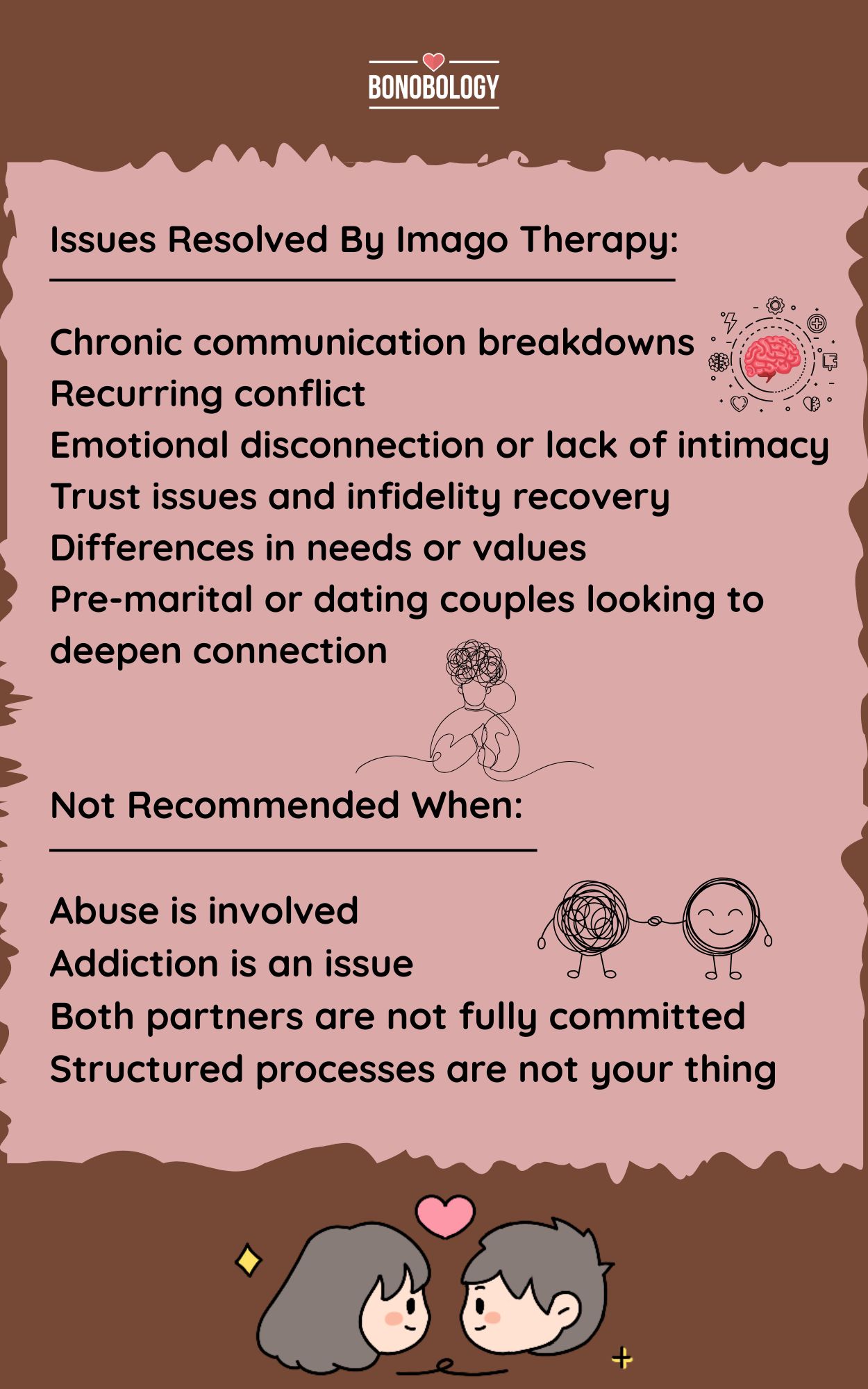
Typical issues and situations where Imago Therapy is used include:
- Chronic communication breakdowns: If you struggle with not feeling heard, or conversations quickly turn into yelling or silent treatments, Imago provides a structured way to talk that prevents those derailments
- Recurring conflict: Couples stuck in a loop of recurring disagreements or fights can benefit. Imago doesn’t teach avoidance of conflict, but rather how to use conflict as a doorway to important conversations and conflict resolution therapy work
- Emotional disconnection or lack of intimacy: Perhaps you feel like roommates more than lovers, or there’s a lack of intimacy and emotional distance. By practicing intentional dialogues and spending focused time on the relationship, Imago Therapy can help rekindle emotional connection and closeness
- Trust issues and infidelity recovery: Imago can be part of the healing process for couples rebuilding trust after breaches like infidelity, or those dealing with jealousy and insecurity. The structured sharing can help create a safe environment to express hurt and begin forgiveness
- Differences in needs or values: Maybe one of you needs more affection or validation and the other doesn’t know how to provide it; Imago dialogue helps articulate these needs. Or you have different conflict styles; Imago can help each understand the other’s approach without judgment
- Pre-marital or dating couples looking to deepen connection: You don’t have to be in crisis to use Imago. Some couples proactively use Imago marriage therapy techniques to strengthen their bond and prevent future problems
Related Reading: Panromantic: What Does It Mean to Be One?
When is imago therapy not recommended?
Importantly, Imago Therapy assumes a baseline of goodwill and safety between partners. Here are some situations where Imago Therapy would not be appropriate:
- If one partner is abusive, those issues must be addressed first before couples therapy can be effective. Imago sessions require vulnerability; it wouldn’t be safe or fair for a victim of abuse to be vulnerable with their abuser in therapy
- Similarly, if someone is deep in addiction, they may not be emotionally present or honest enough for the process. In such cases, individual therapy or rehab is the first step; Imago therapy may only be effective after such immediate threats are resolved
- If you’re just “testing the waters” or one person already has a foot out the door, it might not be the right time. A different form of counseling or a frank discussion about commitment might be needed first
- People who strongly dislike structured processes might chafe at the scripted nature of Imago dialogue. A skilled therapist can sometimes adapt the process, but it’s worth noting that Imago isn’t a casual chat; it’s a bit like learning a new communication skill, which not everyone is open to
In summary, Imago Relationship Therapy has helped couples dealing with everything from constant bickering to years of simmering resentment. However, it’s not a cure-all for every situation; issues like violence, severe addiction, or a partner having lost interest are contra-indications until those issues are handled. For the average couple who knows they love each other but just can’t get past their “stuck” patterns, Imago Therapy can be a game-changer.
What Techniques Are Used In Imago Relationship Therapy?
The heart of Imago Therapy lies in its unique communication tool called the Imago Dialogue. If you take away one technique from this approach, it will likely be this structured conversation method. An Imago therapist guides you and your partner through the dialogue process until you can eventually do it on your own.
Imago dialogue
In each dialogue, one person is the Sender, the one who speaks and shares feelings, and the other is the Receiver, the one who listens and responds using the dialogue steps. Later, you switch roles so both get to be heard. The dialogue has three main steps for the Receiver:
- Mirroring: The Receiver repeats back or paraphrases what the Sender said, to confirm they heard it correctly. For example, if your partner says, “I feel anxious when you come home late without calling,” your mirroring might be: “So what I’m hearing is that you feel anxious when I come home late and I haven’t called.”
- Validation: After mirroring the content, the Receiver validates the Sender’s perspective. Validation doesn’t mean you necessarily agree; it means you can see how, from their point of view, it makes sense
- Empathy: Finally, the Receiver tries to imagine the Sender’s feelings and reflects that back, showing that they are emotionally tuning in
Apart from Imago DIalogue, some other techniques and exercises include:
- Using Sentence Stems: In early sessions, a therapist might give prompts like “Something I appreciate about you is…”, “I imagine you might be feeling…” to help partners get comfortable expressing positive feelings and empathy. This builds goodwill and confidence in the process
- Childhood Reflection Exercises: Since Imago focuses on childhood wounds, therapists often ask each partner to share stories about their childhood, especially around the pain points. They may then help the partner link those experiences to current triggers
- Behavior Change Requests: After some dialogues, the therapist might guide a couple in converting complaints into requests. For instance, once a concern is heard and validated, the Sender might formulate a proactive request: “It would help me if you could send a quick text if you’re running late.”
- Romantic Exercises: Imago therapy also encourages rebuilding emotional connection. One of Hendrix’s tenets of Imago therapy is “re-romanticizing” the relationship through small surprises, dates, and appreciations. A therapist might “assign” couples to do something fun together, or to exchange appreciations daily. These acts help balance the heavy emotional work with positive bonding
- Imagery and Dialogue with Inner Child: Some Imago workshops involve guided imagery where you visualize your partner as a little child who was hurt, and likewise visualize yourself as a child
- Therapist’s Role: An interesting aspect is that Imago therapists don’t take sides or even spend a lot of time giving advice. The relationship itself is considered the client or the “patient.” The therapist acts as a facilitator of dialogue. They’ll structure the conversation, gently instruct and correct the partners in the dialogue process, and ensure emotional safety
- Session structure and format: Imago Therapy is typically done with both partners present. Sessions are often weekly and last about an hour, similar to other therapy. Some Imago therapists offer longer sessions because the dialogue process can take time, especially if a couple has a lot to unpack
- Closing Exits: Another technique often used is “closing exits.” Exits are ways we avoid intimacy or tension. An Imago therapist might help you identify your “exits” and gently encourage closing them so that you’re not escaping the relationship but staying present to do the work
- Imago therapy online. Many people wonder if this structured approach can work via teletherapy or Zoom. The answer appears to be yes as numerous Imago therapists offer online sessions, and couples have successfully done the dialogue through video calls. The key is having a quiet, private space on each end and possibly using certain gestures to compensate for not being in person
In summary, the techniques of Imago Therapy revolve around intentional communication and empathy-building exercises. The structured dialogue is the star of the show, and when practiced consistently, it can truly become second nature. In fact, the goal is for couples to eventually become their own therapists in a way and to use these techniques at home whenever needed.
What To Expect In Imago Relationship Therapy
Starting Imago Therapy can be a bit of an emotional journey. Here’s what you can expect if you decide to give it a try:
1. Emotional experience
Be prepared to feel. Imago Therapy often goes deeper than surface-level issues, so it can bring up strong emotions. In early sessions, it’s not uncommon for one or both partners to get tearful as they talk about long-suppressed feelings or childhood memories. The good news is that these emotions, once expressed and met with empathy, tend to bring couples closer.
On the flip side, it can also be challenging. You might hear things from your partner that are hard to accept. The structure helps stop arguing in the moment, but you might still feel defensive or guilty internally. The therapist will encourage you to stick with the process and remind you that these feelings are part of the growth. It’s important to trust the process and not storm out when something uncomfortable comes up. Over time, facing these uncomfortable feelings leads to a big payoff in intimacy.
2. Timeline

Imago is not typically a quick, one-session fix. Often, couples commit to a series of sessions, say 8 to 12 sessions, to really learn and integrate the techniques. Some notice small improvements even after the first few sessions, like a reduction in the intensity of fights or feeling a bit more hopeful. But deeper changes may take a few months or longer. A typical course of Imago Therapy might look like weekly sessions for 2-3 months, then maybe tapering to biweekly or monthly check-ins as you gain skills.
Pink Box: A study in 2017 looked at couples over 12 weeks of Imago therapy and found improvements in relationship satisfaction by the end. In plain terms, couples felt happier in their relationship after three months of Imago sessions compared to before. They likely fought less or at least fought better, and felt closer
3. Common challenges or resistance
It’s good to know that almost every couple feels frustrated with the dialogue process at first.
- Many people feel awkward doing the mirroring and using the phrase, “What I hear you saying is…” It can even provoke some laughter or eye-rolling initially. That’s normal! The therapist will probably smile and encourage you to try it anyway, explaining the rationale
- Imago asks you to speak honestly about your feelings and needs; no sarcasm, no half-truths. If you’re not used to that, it can feel risky
- Sometimes one partner is more invested in therapy than the other at the start. Perhaps one is skeptical or just less emotionally expressive. Imago can still work, but the hesitant partner might need to see that this isn’t about being ganged up on by the therapist and their spouse. Often by the second or third session, the more reluctant person sees that the process is fair and not about blame
4. Typical session flow
At the start, expect the therapist to educate you a bit; they might talk about the imago concept, maybe have you fill out some compatibility questions about your relationship or about your childhood. They’ll teach you the dialogue steps and possibly do a demonstration. You and your partner will then practice with a real issue. Early on, sessions are very much learning-oriented.
As you progress, sessions shift into addressing your key issues using the dialogue. One week you might tackle an incident that happened. Another week, you might discuss a longstanding sensitive topic using the dialogue format. The therapist is always there as a safety net, to ensure it doesn’t get out of hand and to coach you through sticky moments.
Related Reading: Love Songs For Him: The Ultimate Guide To Expressing Your Heart
5. Homework and practice
Expect to get homework! Often it’s practicing a dialogue at home on a minor issue or doing an “ appreciations dialogue”. Sometimes couples get worksheets to identify their childhood wounds or their imago traits. Taking the homework seriously can really accelerate your progress. It might feel a bit like a couples workshop or class at times; that’s actually part of Imago’s charm, it’s very hands-on.
6. The journey
Imago Therapy can be an emotional rollercoaster, but generally it moves from pain to hope.
- At first, you might feel a mix of hope and discouragement
- Midway, couples often hit a stride where they’re having breakthroughs; big “aha” moments where you finally understand why your partner behaves a certain way, or you realize you’re actually healing old hurts. This can be exhilarating. You might find yourselves falling back in love in a deeper, calmer way
- By the end of a successful course of Imago, couples report feeling more connected, more compassionate, and better equipped to handle future conflicts on their own. They’ve essentially learned a new “language” to speak to each other
In summary, expect Imago Therapy to be a bit of work, emotionally and in terms of learning skills, but very rewarding. It’s not easy to confront your own childhood wounds or to listen without reacting, but the payoff is seeing your partner in a whole new light and feeling seen and safe in return. It turns arguments from a zero-sum tug of war into a joint exploration of “How can we understand and support each other better?”. And that, frankly, can be relationship-changing.
Related Reading: 101 Questions To Ask Your Husband For Fun
Benefits Of Imago Relationship Therapy
When Imago Therapy works well, what benefits can you and your partner expect? Based on the Imago approach’s goals and what couples often report, here are some key benefits:
- Improved communication: Couples learn a new way to talk to each other rather than at each other. After practicing Imago Dialogue, you’ll likely find you interrupt less, listen more, and can discuss tough topics without immediately escalating into a fight
- Deeper empathy and understanding: Imago therapy puts you in each other’s shoes regularly. By mirroring and validating, you come to really grasp your partner’s feelings and triggers
- Emotional safety and connection: Because Imago emphasizes creating a non-judgmental, safe space, couples often regain a sense of emotional safety with each other. When you’re no longer afraid that bringing up a concern will lead to a shouting match or cold shoulder, you relax more in the relationship. This safety is the bedrock of emotional connection in relationships
- Healing of past wounds: Imago Therapy is unique in that it explicitly aims to heal childhood wounds through the relationship. It’s almost a re-parenting phenomenon but done by your partner with you doing the same for them
- Transforming conflict into growth: A big benefit is a mindset shift: you start to approach disagreements with curiosity rather than hostility. When a conflict arises, an Imago-trained couple might think, “Alright, what is this really about for each of us?” instead of “Here we go again, time to win this argument.”
- Enhanced intimacy and rekindled romance: Imago doesn’t directly give sex tips or romantic advice, but by clearing the air of resentments and improving communication, it often has a positive side-effect on your love life
- Personal growth and self-awareness: Imago might be couples therapy, but you inevitably learn a ton about yourself. You become more aware of your triggers, your reactions, and why you might be projecting certain fears onto your partner. This self-awareness can benefit you outside the relationship too
Pink Box: A more recent 2023 study in Journal of Education and Health Promotion, conducted in Iran, specifically reported that Imago therapy had a significant effect on improving marital satisfaction and positive emotional experience towards the spouse among men in conflicted marriages. In this study, men who underwent Imago therapy, compared to a control group, were more satisfied in their marriage and had more positive feelings toward their wives afterward. This is notable because it shows the approach can be effective across different cultures and even when focusing on one gender’s experience
How To Begin Imago Relationship Therapy
If you’re intrigued by Imago Therapy and want to give it a try, you’re probably wondering how to get started. The good news is there are many resources and trained therapists out there. Here’s a roadmap:
1. Finding a certified imago therapist
Look for therapists who specifically mention Imago Relationship Therapy or being “Imago-certified.” Imago Relationships International (IRI) is the official organization that certifies therapists in this method. On their website, you can use the therapist finder tool to search for Imago therapists by location.
Related Reading: 150 Questions To Ask Your Wife To Deepen Your Connection
2. Consider workshops vs. private therapy
Imago offers two main avenues: the traditional weekly couples therapy sessions, and Imago workshops/retreats. Both have their pros and cons:
- Therapy Sessions: These are one-on-one. They allow more privacy and customization to your issues. You schedule them like any therapy, usually once a week or biweekly. Cost might range similar to other therapy; depending on location, often $100-$200 per session, though some therapists have sliding scales
- Workshops/Retreats: These are typically group events with multiple couples. A popular one is the “Getting the Love You Want” weekend workshop, often led by certified presenters. You and your partner would spend a full weekend learning about Imago, doing exercises just with each other
3. Online or in-person
In today’s world, many therapists offer Zoom sessions. If you live in a region with no Imago therapists nearby, online is a great option. Imago dialogue via video works, as mentioned, but ensure you have a good internet connection and a quiet space. If in-person is available and you prefer that energy, find a local therapist and arrange a comfortable office setting.
Related Reading: Daddy Kink: What It Is And How It Works
4. Questions to ask a potential therapist
When you’ve found someone, many therapists offer a free 15-minute consultation call. Use that to get a feel for them. You might ask:
- “Are you a certified Imago therapist, and how long have you been practicing?”
- “How do your Imago sessions usually run? Do you combine it with other approaches?”
- “Have you worked with couples with [your specific issue] before using Imago?”
- Logistical questions: fees, cancellation policy, session length, etc., like any therapy.
- If relevant: “Do you offer intensive sessions or workshops as part of your work?”
Pay attention to how you feel talking to the therapist. You want someone you both feel comfortable with, who comes across as balanced and empathetic. Given Imago’s nature, ideally the therapist makes both of you feel at ease.
5. Costs and logistics
As mentioned, cost can vary. Workshops might cost a few hundred dollars; private sessions might be per session fee. Some Imago therapists may slide scale or have package deals. Also consider the time commitment: weekly sessions are common initially. Make sure you and your partner can carve out that time consistently, and arrange things like childcare if needed.
Related Reading: 10 Essential Online Dating Tips For Women
6. Getting your partner on board
What if you’re sold on trying Imago but your partner is lukewarm or skeptical about counseling? Some tips:
- Share some info with them; maybe have them read this guide or the Hendrix book’s intro, or watch a short video of a couple demonstrating Imago dialogue. Sometimes seeing what it actually is can reduce fear
- Emphasize that it’s a collaborative, no-blame approach. Some people resist therapy fearing they’ll be blamed as the “bad guy.” Explain Imago is not about finger-pointing, it’s about both of you understanding each other
- Perhaps suggest trying just a couple of sessions or a weekend workshop as an experiment, rather than an open-ended commitment. Knowing it’s not infinite can help someone agree to start
- If they really refuse couples therapy, you might ask if they’d read the book with you and try a few exercises at home. That could be a gentle intro and might lead them to see the value
- If all fails and they won’t engage, consider doing individual Imago-informed therapy yourself. Even one person changing communication patterns can sometimes improve dynamics
7. Workshops and retreats info
If you opt for a workshop or retreat, check Imago official website or local counseling centers. Some workshops are for specific groups, e.g., workshops for Christian couples, for LGBTQ couples, for couples with children, etc. Choose one you’re comfortable in.
8. Plan the timing
Starting Imago therapy during a relatively stable time can be helpful. If you’re in the middle of a huge life transition like having a baby or moving homes next week, etc., you might have extra stress that could overwhelm the process. That said, sometimes couples precisely seek therapy during transitions; just be mindful of stress load. Ensure you can devote some energy to this. It doesn’t mean waiting for a “perfect time”, but at least not sabotaging it by scheduling first session on the day of a work deadline or something.

9. Attitude going in
Go in with an open mind and some patience. It’s okay if you feel nervous; tell the therapist that, they’ll help ease you in. And remember the therapist is not a judge or an umpire; they are a facilitator on your team.
FAQs
This can vary, but many couples report noticing some positive changes after just a few sessions. Typically, within 6-12 sessions, couples see significant improvements in how they communicate and handle conflict. Of course, every relationship is different: if your issues are very deep or longstanding, it might take longer to unravel them. Sometimes couples continue therapy for 6 months to a year if they have a lot of layers to work through or just want ongoing support.
Yes, Imago therapy online can be effective. Many therapists offer Imago sessions via video calls, and couples have successfully done the Imago Dialogue through platforms like Zoom. You, your partner, and the therapist join a virtual meeting; it’s helpful if you and your partner are in the same room together on one camera, but if you’re long-distance you can join from separate locations and the therapist will facilitate just as in person. The key elements can be done through video; you just have to be careful to speak one at a time and perhaps exaggerate nods or verbal affirmations so your partner knows you’re engaged.
First, try to have a calm, honest conversation about their concerns. They might fear being blamed or think a therapist will take sides. Explain that Imago is not about judging who’s right or wrong, but about improving understanding for both of you. You could suggest reading “Getting the Love You Want” together or watching a short video of Harville Hendrix explaining Imago to understand it better. If they’re not up for therapy sessions right away, perhaps propose a compromise: attend just one workshop or a few sessions as an experiment, with no pressure to continue if they truly hate it.
Final Thoughts
Imago Therapy offers a refreshing and profound way to look at your relationship. It involves truly understanding your partner and yourself on a deeper level. By viewing your conflicts through the Imago lens, you begin to see that many of your frustrations with each other are really pain from the past asking to be healed. Instead of being adversaries, you become allies in healing those old wounds and growing together.
What Is Breadcrumbing In Dating? Signs And How To Respond To It
Your contribution does not constitute a charitable donation. It will allow Bonobology to continue bringing you new and up-to-date information in our pursuit of helping anyone in the world to learn how to do anything.















Je souhaite partager mon merveilleux témoignage sur la façon dont j’ai reconquis mon mari. Je veux informer le monde entier qu’il existe un véritable marabout en ligne, puissant et authentique. Il s’appelle Baba Wale Wiseman. Il m’a récemment aidée à renouer avec mon mari qui m’avait quittée. Lorsque j’ai contacté Wiseman, il a jeté un sort d’amour pour moi et mon mari, qui prétendait ne plus vouloir me connaître, m’a appelée et a commencé à me supplier. Si vous lisez cet article et avez besoin d’aide, sachez que Wiseman peut vous aider dans tous les domaines : réconciliation conjugale, guérison de maladies, affaires judiciaires, sorts pour la grossesse… Nous sommes aujourd’hui comblés. Wiseman lui a fait prendre conscience de l’amour et du besoin que nous avions l’un de l’autre. Cet homme est sincère et bienveillant. Il peut également vous aider à réparer votre relation brisée. J’ai retrouvé mon mari ! C’était un véritable miracle ! Pas de thérapie de couple et notre vie amoureuse se porte à merveille. Contactez cet homme exceptionnel si vous rencontrez des difficultés et souhaitez une solution durable : par e-mail : [email protected], WhatsApp : +16452205737, Viber : +18594463868
Je souhaite partager mon merveilleux témoignage sur la façon dont j’ai reconquis mon mari. Je veux informer le monde entier qu’il existe un véritable marabout en ligne, puissant et authentique. Il s’appelle Baba Wale Wiseman. Il m’a récemment aidée à renouer avec mon mari qui m’avait quittée. Lorsque j’ai contacté Wiseman, il a jeté un sort d’amour pour moi et mon mari, qui prétendait ne plus vouloir me connaître, m’a appelée et a commencé à me supplier. Si vous lisez cet article et avez besoin d’aide, sachez que Wiseman peut vous aider dans tous les domaines : réconciliation conjugale, guérison de maladies, affaires judiciaires, sorts pour la grossesse… Nous sommes aujourd’hui comblés. Wiseman lui a fait prendre conscience de l’amour et du besoin que nous avions l’un de l’autre. Cet homme est sincère et bienveillant. Il peut également vous aider à réparer votre relation brisée. J’ai retrouvé mon mari ! C’était un véritable miracle ! Pas de thérapie de couple et notre vie amoureuse se porte à merveille. Contactez cet homme exceptionnel si vous rencontrez des difficultés et souhaitez une solution durable : par e-mail : [email protected], WhatsApp : +16452205737, Viber : +18594463868