

Key Takeaways
- Dating apps for teens vary enormously in safety. Yubo, Spotafriend, and BeFriend invest in real age verification and content moderation. Wizz and Kik do not
- Almost no teen app has meaningful age verification beyond asking for a date of birth. That single barrier is easy to bypass
- The search intent for teen dating apps is split: teens look for connection. Parents look for safety guidance. This guide addresses both
- The biggest documented risks are sextortion, predatory adult access, location exposure through default app settings, and the mental health toll of appearance-based swiping
- Safe habits such as location off, no personal details, a trusted adult who knows which apps you’re on matter as much as which platform you choose
- LGBTQ+ teens have good options: Teen Chat, BeFriend, and CrushZone all explicitly welcome users across sexual orientations and gender identities
- Parents: the conversation matters more than the ban. Teens who feel they can come to you when something goes wrong are meaningfully safer than teens who hide everything.
We’re already aware of Tinder, Bumble, and OkCupid and how they’ve reshaped online dating. But dating apps for under 18 is a topic that gets less serious attention than it deserves, given how many teenagers are actively using them.
This guide seeks to address that. If you’re a teen, you’ll find honest, practical write-ups on which apps are worth your time, what to watch out for, and how to use them without making decisions you’ll regret. If you’re a parent, there’s a dedicated section toward the end that covers real risks, age-specific guidance, and conversation approaches that don’t start a fight.
According to data from the Pew Research Center, 24% of American teenagers with dating experience have met someone they first dated online. A 2022 report by Thorn, a nonprofit that builds technology to protect children from sexual abuse, found that one in three teens now uses social platforms specifically to meet romantic interests. Not everyone who is meant to be in your life will be a deskmate from seventh-grade biology or a family friend you see on fishing trips. For teenagers in smaller towns or with limited social circles, these apps can provide real access to connection. The question is which ones are worth using and how to use them without taking unnecessary risks.
Quick Take: What Are Dating Apps For Teens?
Dating apps for teens are social platforms designed for users aged 13–19 to connect with peers, make friends, and explore romantic connections in a moderated environment. The safest options separate teen and adult user pools, include some form of age verification, and provide tools like content moderation, location privacy, and in-app reporting. Popular examples include Yubo, Spotafriend, and Wizz, though each carries a different safety profile.
What Are Teen Dating Apps?
Table of Contents
The label “teen dating app” is looser than it sounds. Some platforms are built exclusively for teenagers and actively separate their user base by age group. Others allow users as young as 17 but exist more in young adult territory. And then there are mainstream platforms such as Snapchat, Discord, TikTok that teenagers regularly use for romantic connection even though that was never the platform’s stated purpose.
What all of them have in common is this: they let teenagers meet people outside their immediate social circle. That has genuine value. Not every high school is large enough to find a compatible person, and for LGBTQ+ teens in less accepting communities, online platforms can provide connections that are not available locally.
The question isn’t whether teenagers should connect online. The question is which platforms do it responsibly. If you’ve just come out of a relationship and are wondering how to start dating again after a breakup, teen-specific apps offer a lower-pressure entry than jumping straight back into adult platforms.
Are teen dating apps safe?
It depends on the app and on how much awareness surrounds it. No platform is risk-free.
A study published in the Journal of Adolescent Health found that approximately 1 in 5 young people encounter unwanted online sexual exposure. The FBI has documented a significant rise in sextortion cases involving minors, many originating on platforms that market themselves as teen-friendly. These numbers should inform which apps you recommend and how. If you want a fuller picture of what can go wrong, Bonobology’s guide to the dangers of online dating covers the mechanics of online risk in detail.
Some apps have invested in real safety infrastructure including,
- Face recognition at sign-up
- Age-estimation technology
- Separated teen and adult communities
- Active content moderation
Others rely on nothing more than asking for a birthdate. The difference matters enormously, and the app descriptions below reflect it.
What is the legal age for dating apps?
Most dedicated teen social apps set a minimum age of 13, in line with COPPA (Children’s Online Privacy Protection Act) in the US. Some require users to be 17 or 18. But almost none have meaningful age verification. They ask you to enter a birthday. That’s the entire barrier. A 12-year-old can type in a different year. An adult can claim to be a teenager. This is why platform policy alone is never enough, and why parental awareness needs to work alongside app design, not instead of it.
Related Reading: 21 Best Tech Gifts For Teens – Cool Gadgets And Electronic Toys
The 13 Best Dating Apps For Teens In 2025
Quick-Reference: Dating Apps For Teens At A Glance
| App | Min. Age | Cost | Platform | Best For | Safety |
| Yubo | 13+ | Free/Premium | iOS + Android | Live streams, group chats | ★★★★ |
| Spotafriend | 13–19 | Free | iOS + Android | Casual teen friendship | ★★★★★ |
| Wizz | 13+ | Free | iOS + Android | Wide reach; higher risk | ★★ |
| Hoop | 13+ | Free | iOS + Android | Snapchat friend-finding | ★★★ |
| BeFriend | 13+ | Free | iOS + Android | Interest-based friendships | ★★★★ |
| Skout | 17+ | Free/Premium | iOS + Android | Young adults 17+ | ★★★ |
| Hot Or Not | 13+ | Free/Premium | iOS + Android | Casual connections | ★★★ |
| Taffy | 17+ | Free | iOS + Android | Conversation-first | ★★★★ |
| AlloTalk | 13+ | Free | Web only | Group chats, chat rooms | ★★★ |
| Teen Chat | 13+ | Free | Web only | LGBTQ+ friendly chat | ★★★ |
| Teens.Town | 13+ | Free | iOS + Android | Social discovery | ★★★ |
| CrushZone | 12–18 | Free | Web only | Community forums, games | ★★★ |
| Coffee Meets Bagel | 17+ | Free/Premium | iOS + Android | Serious connections | ★★★★ |
| Kik | 13+ | Free | iOS + Android | Messaging — use with caution | ★★ |
Apps 1–5 are the most recommended. Apps 6–11 are worth knowing but come with caveats. Apps 12–13 need extra caution.
Kids, as long as you’re being safe, honest, and careful in these online spaces, there is no reason not to try the apps below. Parents will be concerned and as adults navigating a generational gap, they have real questions. Be patient with them. Creating an identity online helps you build a social network, find like-minded people, and have genuine experiences beyond your immediate geography.
For example, Hannah joined Yubo a couple of months after her first breakup with her high school boyfriend Baz. Two months in, she already had friends she genuinely looked forward to talking to after school. Hannah says the connections distracted her enough to stop feeling sorry for herself after the breakup. What she values most is having close friends across the country without leaving her room.
So if Tinder’s age policy is standing in your way, the apps below are free, designed for a younger audience, and mostly moderated. Make sure you tell a parent or trusted adult which apps you’re on, meet new people in public places first, and keep private details private. But remember to be careful about whom you talk to anyway.
1. Yubo — As Safe As It Can Get In Dating Apps For Under 18

Yubo, formerly Yellow, is the gold standard for teen-app safety infrastructure. It requires parental permission for accounts created by users under 18, uses face recognition and age-estimation technology at sign-up, and runs a reverse image search on uploaded photos to catch fake profiles. The teen community is separated from the adult community. That investment is meaningful. Most competitors don’t get close.
Yubo is built around live streaming and group interaction rather than one-to-one romantic matching, making it closer to a social discovery platform than a dating app. Starting at age 13 and going up to 25, if you’re in this age bracket, you can find your place here. It’s the kind of space where you can practise online flirting naturally within a group setting, rather than being flung into one-on-one pressure immediately.
Yubo Features
- Age limit: 13 to 25 (teen and adult communities separated)
- Live streaming viewable by any platform user
- Yubucks in-app currency to boost profile and video visibility
- Tinder-style swiping to express interest and match
- Option to turn off camera and microphone during a live stream
Available on: App Store and Play Store
Cost: Free to download; premium subscription available
Related Reading: 21 Best Dating Apps For Relationships
2. Spot a friend — One Of The Best Under 18 Dating Apps
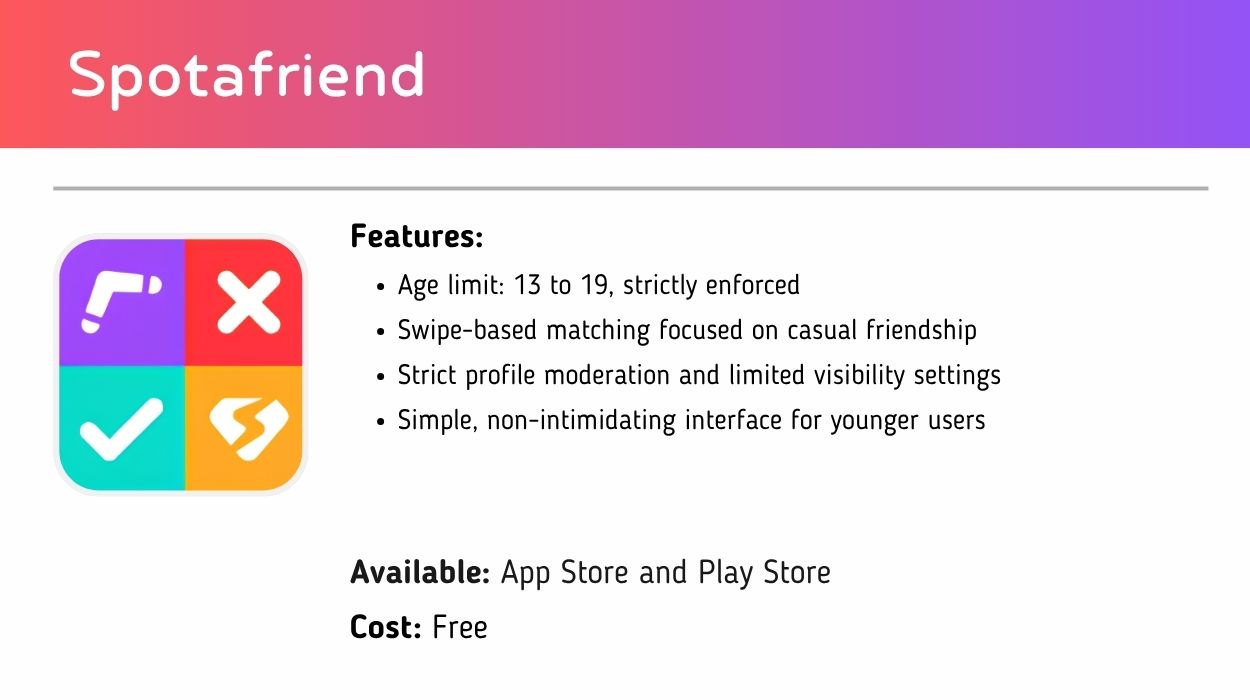
Designed exclusively for users aged 13–19, Spotafriend removes the ambiguity of age-mixing that undermines most other platforms. It’s structured like a dating app — profile photos, swiping, matching — but positions itself around making friends rather than finding romance. The exclusivity is a feature: once you turn 20, you’re out. This is the app to recommend to a younger teen who wants a low-pressure entry into online social spaces without the risk of adult users in the same pool.
Spotafriend features strict profile moderation and limited visibility settings. It’s the closest thing to a safe, early relationship experience in app form. It’s structured, gentle, and without the social landmines of adult platforms.
Spotafriend Features
- Age limit: 13 to 19, strictly enforced
- Swipe-based matching focused on casual friendship
- Strict profile moderation and limited visibility settings
- Simple, non-intimidating interface for younger users
Available on: App Store and Play Store
Cost: Free
3. Wizz — What Teens And Parents Both Need To Know
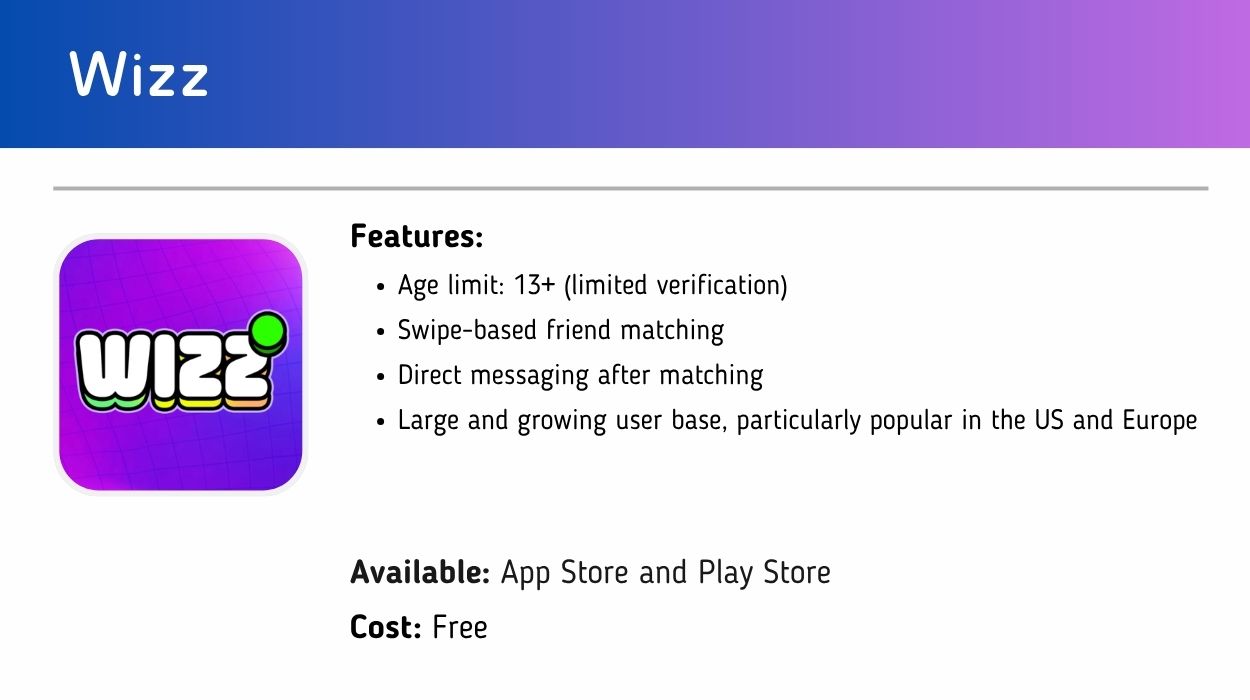
Wizz is one of the most downloaded teen social apps of the last two years, and its absence from older lists is a real gap. It’s what teenagers are actually using right now. The app works through a swipe-and-match interface similar to Tinder but positions itself as a friend-making platform for users 13 and up.
Coverage has been genuinely mixed. Wizz has faced documented criticism for weak age verification — users can bypass restrictions easily — and it has appeared in multiple reports about predatory contact with minors. Knowing how to spot online dating red flags before downloading Wizz isn’t optional; it’s the baseline. Teens using Wizz should keep location services off, share no personal details in their bio, and tell a trusted adult they’re on the platform.
Wizz Features
- Age limit: 13+ (limited verification)
- Swipe-based friend matching
- Direct messaging after matching
- Large and growing user base, particularly popular in the US and Europe
Available on: App Store and Play Store
Cost: Free
Safety Note
Wizz has one of the weakest age verification systems on this list. Adults can and do create profiles claiming to be teenagers. If you’re a parent and find this app on your teen’s phone, have a direct conversation about who they’re talking to and whether those people have verified their age in any meaningful way.
4. Hoop — Snapchat Friend-Finding For Teens

Hoop links directly to Snapchat and works as a discovery layer on top of it. You swipe through profiles and, when there’s mutual interest, Hoop shares Snapchat usernames so you can connect there. It’s one of the most-used teen social apps among the 14–17 demographic.
The Snapchat connection cuts both ways. Many teens are already comfortable on Snapchat and trust it as a social layer. But once contact moves there, Hoop’s moderation disappears — you’re in a private chat with no platform oversight. That’s worth factoring in, particularly since Snapchat DMs are one of the routes teens use to date online successfully but also one of the more common contexts for unwanted pressure.
Hoop Features
- Age limit: 13+
- Swipe-based matching that shares Snapchat usernames on mutual interest
- Hobby and interest tags on profiles
- Simple, fast interface
Available on: App Store and Play Store
Cost: Free (in-app currency for additional connection requests)
Related Reading: 5 Things To Consider Before Sending Nudes
5. Be Friend — Friendship Before Flirting

BeFriend was built on the idea that friendship should come before anything else. It uses interest-based matching, an incognito mode for users who want more control over their visibility, and an identity-affirming design that makes it particularly welcoming for LGBTQ+ teens. The focus on shared interests such as books, music, hobbies, sports rather than appearance-first swiping makes it one of the more thoughtfully designed apps on this list.
If you’re looking for something that feels closer to a healthy relationship dynamic from the start—connection built on genuine compatibility rather than a photo rating—BeFriend is the most intentional option for teens who want that.
BeFriend Features
- Age limit: 13+
- Interest and hobby-based matching
- Incognito mode for controlled visibility
- LGBTQ+ inclusive design
- Friendship-first orientation with no appearance-first swiping
Available on: App Store and Play Store
Cost: Free
6. Skout — A Small Community
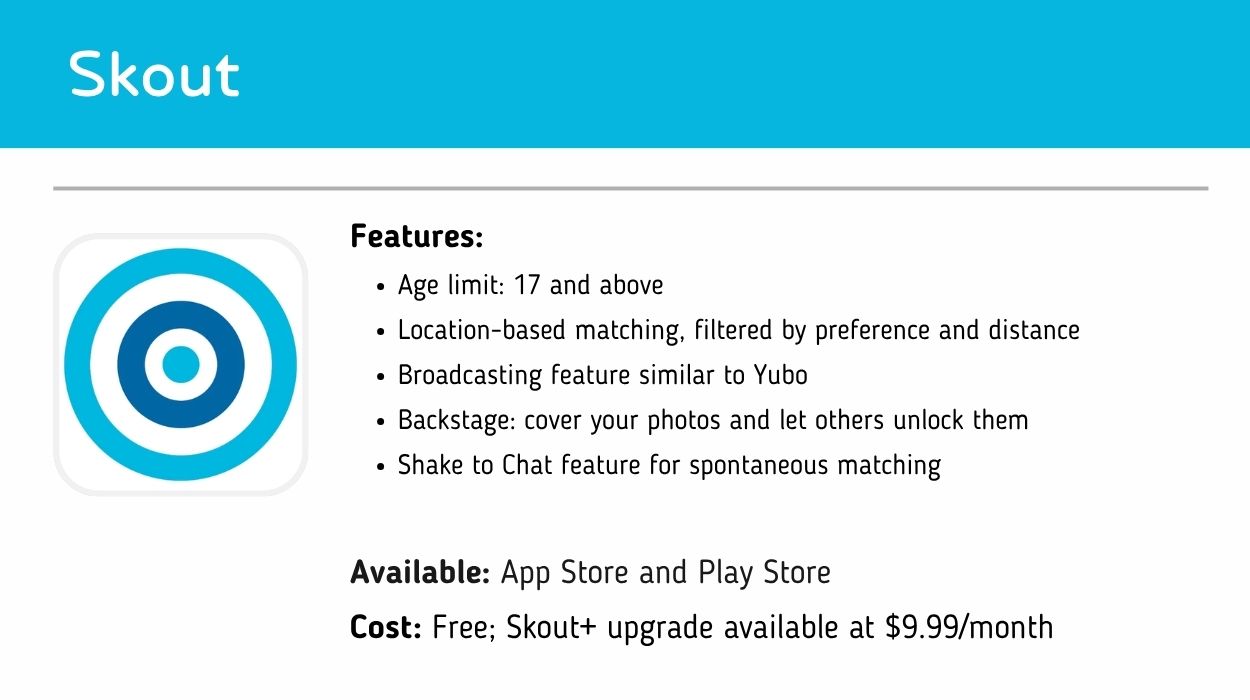
Skout requires users to be at least 17, putting it firmly in young adult territory. It’s location-based, works like a predecessor to Tinder in its interface, and maintains separate teen and adult communities. With features like “Shake to Chat” — matching with someone shaking their phone at the same time — and travel features for connecting with people in other cities, it’s built for online flirting in a genuinely fun way. The user base is smaller than it once was, but for 17–18-year-olds, it’s a solid option.
Skout Features
- Age limit: 17 and above
- Location-based matching, filtered by preference and distance
- Broadcasting feature similar to Yubo
- Backstage: cover your photos and let others unlock them
- Shake to Chat feature for spontaneous matching
Available on: App Store and Play Store
Cost: Free; Skout+ upgrade available at $9.99/month
7. Hot Or Not — A Unique Matching Model

With 300 million registered users, Hot Or Not (also stylized HotOrNot) has real scale. Users as young as 13 can register, with 13–17-year-olds separated from adults in the interface. The platform’s defining feature is a photo-rating matching algorithm — it effectively pioneered the concept of reacting to profile photos before Tinder and Facebook made it standard.
One honest note: photo-rating as a social mechanic isn’t the kindest environment for developing self-esteem, particularly for younger teenagers. Once you reach the age where you start looking into dating in college, all you need is to update your age and the same profile carries over. Hot Or Not is good for casual connection; it’s not built for anything serious.
Hot Or Not Features
- Age limit: 13+ (with a separate teen interface)
- Photo-rating based matching algorithm
- Group and private chat
- Available globally with a large user base
- Not designed for serious relationships
Available on: App Store and Play Store
Cost: Free; privileged membership available
8. Taffy — Conversation First
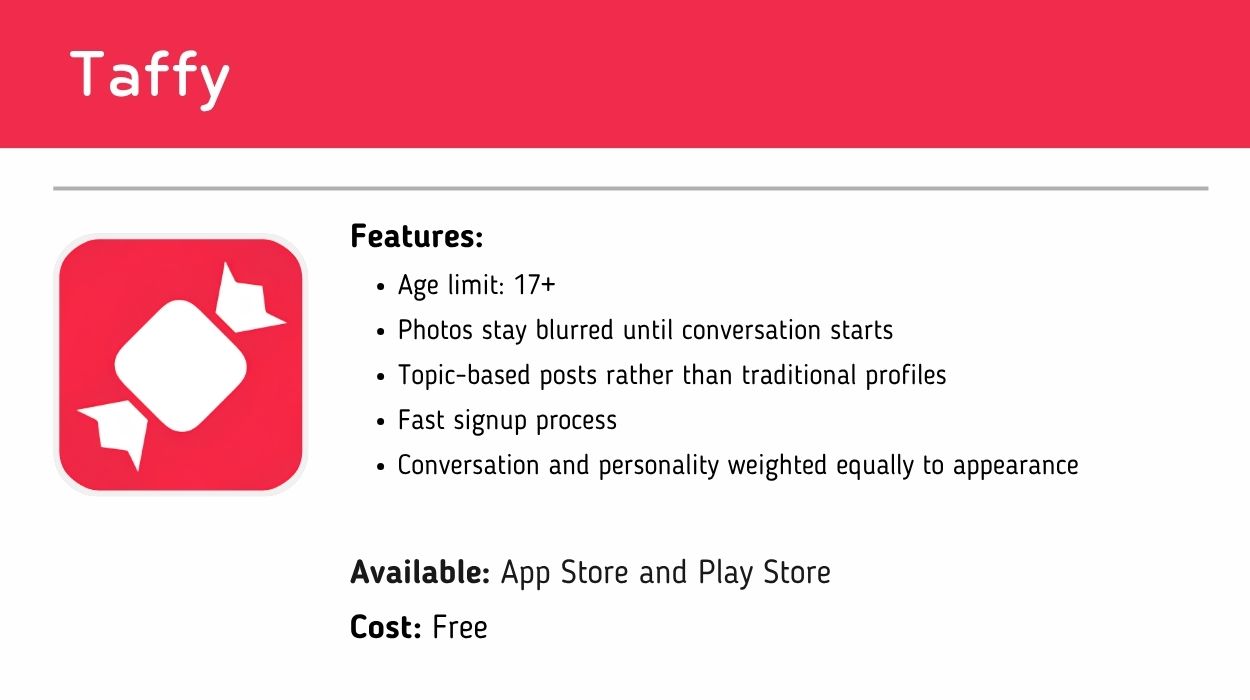
Taffy has a specific mechanic that distinguishes it from everything else on this list: profile photos stay blurred until a conversation has started. That removes the appearance-first dynamic that dominates most swiping apps and reduces the incentive to build a fake profile, since a photo won’t help you anyway. Users create posts rather than traditional profiles, which lets more of a real personality emerge.
One reviewer put it this way: “Tinder exhaustion is a thing, and this app is the alternative. Real conversations with a hint of game mechanics to keep it fun.” For anyone thinking about how to date online successfully without getting trapped in the appearance spiral, Taffy is designed for exactly that. It’s one of the better options for building a connection based on compatibility rather than looks.
Taffy Features
- Age limit: 17+
- Photos stay blurred until conversation starts
- Topic-based posts rather than traditional profiles
- Fast signup process
- Conversation and personality weighted equally to appearance
Available on: App Store and Play Store
Cost: Free
Related Reading: Virtual Dating: Meaning, Benefits, And Ideas
9. AlloTalk — Explore The Fun Of Messaging
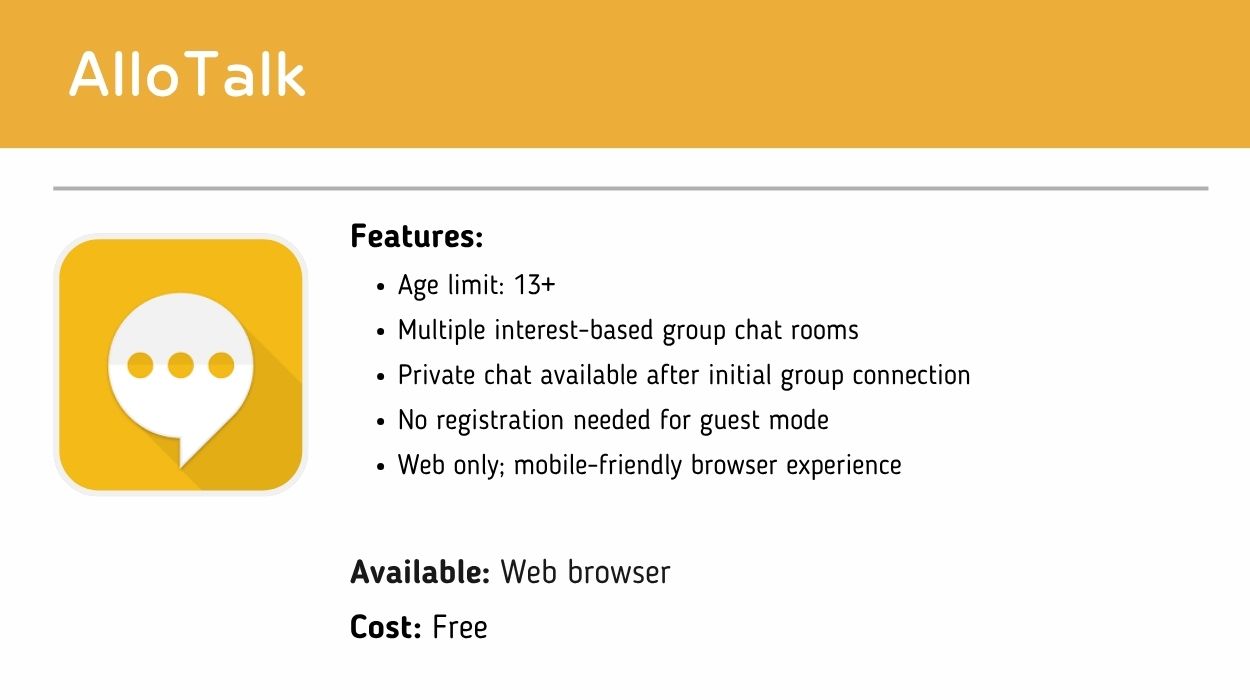
AlloTalk is a web-based teen chat platform built around interest-organized group chat rooms — from books and philosophy to movies and gaming. Once you’ve built a friendship in a group setting, private chat is available. The interface is clean and intuitive, and there’s no registration needed for guest mode.
AlloTalk is one of the safer web-based options for both online flirting and genuine friendship. It’s completely free, has a neat and fresh design, and keeps emojis and stickers updated regularly. There’s no native app yet, but the mobile site works smoothly. If you want to explore FaceTime date ideas with someone you’ve met on AlloTalk, moving from chat to video is a natural next step.
AlloTalk Features
- Age limit: 13+
- Multiple interest-based group chat rooms
- Private chat available after initial group connection
- No registration needed for guest mode
- Web only; mobile-friendly browser experience
Available on: Web browser
Cost: Free
10. Teen Chat — LGBTQ+ Friendly Connections

Teen Chat is a web-based teen chat platform with a long-standing reputation for being welcoming across sexual orientations and gender identities. It’s free, requires no payment for any core feature, and doesn’t try to be more than it is: a space for teenagers to talk to other teenagers.
Moderation is reasonably active, and the platform has enough of a track record to be considered reliable. For LGBTQ+ teens exploring what a healthy relationship looks like at their own pace and within a supportive community, Teen Chat is one of the better starting points.
Teen Chat Features
- Age limit: 13+
- LGBTQ+ inclusive and welcoming community
- Group and private chat options
- Clean web-based interface
- Actively moderated
Available on: Web browser
Cost: Free
11. Teens.Town — One Of The Most Popular Teenage Dating Apps

Teens. Town is one of the more established names in teen social discovery, with a mobile app and a user base spread across multiple countries. It works as a mix of social network and friend-finding tool, with photo sharing, messaging, and profile browsing. For teens who want to practise building a connection from scratch before stepping into higher-stakes adult platforms, Teens. Town offers a reasonably familiar interface.
Teens. Town Features
- Age limit: 13+
- Social discovery with photo sharing and messaging
- Mobile app available
- Global user base across multiple countries
Available on: App Store and Play Store
Cost: Free
12. Crush Zone — For Fun Games And Teenager Meetups

CrushZone is a free teen community platform rather than a one-to-one matching app. It’s mobile-friendly (browser-based, no native app), welcoming to users of any sexual orientation, and includes video chatrooms, group chat sessions, and topic-based forum threads. The forum aspect, where users post and respond on topics from music to shopping, makes it feel more like a community than a dating service. Finding friends online gets more interesting when you’re connecting over shared interests rather than swiping on photos.
Safety note: Verify current activity levels in your region before signing up. CrushZone’s user base has fluctuated in recent years.
CrushZone Features
- Age limit: 12 to 18
- Welcoming to users of any sexual orientation
- Video chatrooms and group chat sessions
- Topic-based forum threads for community discussion
- Web-based mobile interface; no native app
Available on: Web browser
Cost: Free
Related Reading: 11 Best Dating Sites For Nerds, Geeks & Sci-Fi Lovers
13. Coffee Meets Bagel — For Meaningful Matches
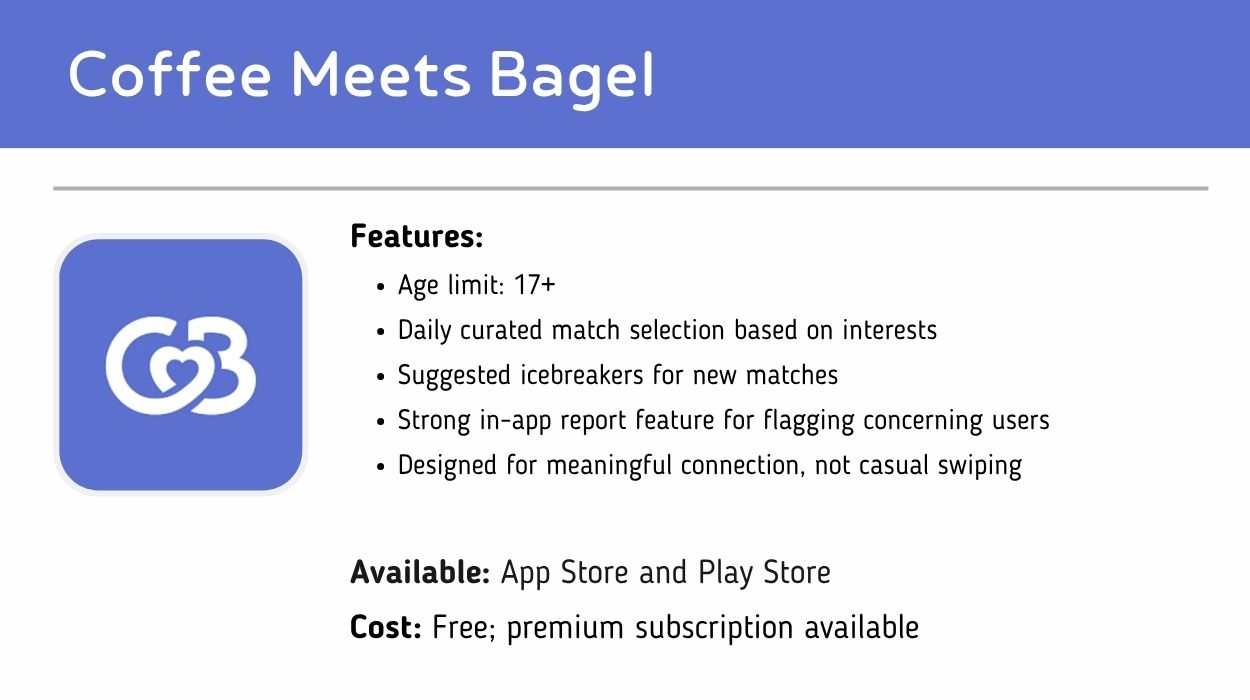
Coffee Meets Bagel is the most intentionally relationship-focused app on this list. Each day it sends a curated selection of matches based on your interests and preferences. It’s a deliberate contrast to unlimited swiping. The app also suggests icebreakers when you match, which helps when dating in college feels socially unfamiliar and you’re not sure how to start a conversation. At 17+, it’s best suited to older teens who want something with more depth than a standard swipe-and-chat setup.
Coffee Meets Bagel Features
- Age limit: 17+
- Daily curated match selection based on interests
- Suggested icebreakers for new matches
- Strong in-app report feature for flagging concerning users
- Designed for meaningful connection, not casual swiping
Available on: App Store and Play Store
Cost: Free; premium subscription available
14. Kik — Approach With Caution
Kik is a messaging app rather than a dedicated dating platform, but teenagers frequently use it to meet new people. Common Sense Media and multiple child safety organizations have flagged Kik repeatedly for hosting mature content and for its documented history with groups trading exploitative content involving minors. It also limits what parents can see of their teen’s activity by design. Knowing the red flags that signal an unhealthy online dynamic becomes particularly important on a platform where oversight is this limited.
Kik Features
- Age limit: 13+
- Messaging-first design with group and private chat
- No dedicated dating features
- Limited parental visibility into conversations
Available on: App Store and Play Store Cost: Free
Safety Note: Kik
Child safety organizations including Common Sense Media have documented Kik’s history with mature and exploitative content. If your teen uses Kik, make sure they understand not to share personal information, photos, or location with anyone they haven’t met in person.
Related Reading: The Dangers Of Online Dating In 2025 And How To Avoid Them
Dating Apps Teens Sneak Onto (That Aren’t Marketed As Teen Apps)
Any parent focused exclusively on dedicated teen dating apps is solving half the problem. The fuller picture is considerably wider.
TikTok, Discord, And Snapchat — The hidden dating layer
Teenagers use the DMs and comment sections of mainstream social platforms for romantic connection far more frequently than they use dedicated dating apps. On TikTok, a comment on someone’s video leads to a DM, which leads to a Discord server or Snapchat exchange. Discord, which is technically a gaming communication tool, has become a significant social hub where teens form close friendships and romantic interests inside interest-based servers.
Knowing the social media red flags that emerge in these contexts matters as much as knowing which apps teens are on. The medium changes; the warning signs don’t. “Does my teen have any dating apps?” is the wrong question. The more accurate question is: who is your teen in private communication with, and on which platforms?

Adult apps with no real age gate
Teenagers access Tinder, Bumble, and Hinge regularly despite all three requiring users to be 18. The method is straightforward: they enter a false birthdate. That’s the entire barrier on most adult dating apps. Bumble and Hinge have made various attempts at age verification, but none comprehensively work. The adult user pool on these platforms is unfiltered, there’s no teen-specific content moderation, and the online dating red flags that adults learn to spot over years of experience are often invisible to a 16-year-old encountering them for the first time.
Related Reading: Online Dating Safety Guide: Protect Your Privacy, Identity, And Emotions
The Real Risks: What No Dating App Will Tell You
Dating apps for teens carry risks their marketing materials don’t highlight. This section is for both teens and parents.
How teens bypass age verification
Almost every app on this list verifies age by asking for a date of birth. No ID check, no facial recognition age gating, no cross-referencing with any external database. A 12-year-old can access a 13+ app by changing the year. An adult can access a “teen-only” platform by claiming to be 16.
Yubo and Spotafriend have added face recognition and age-estimation technology at sign-up, which is meaningfully better. But they’re exceptions. For most apps, age restrictions operate entirely on the honor system. Understanding how catfishing works and the specific behaviors that give fake profiles away is one of the most practical skills a teen on any of these platforms can have.

Sextortion: What it is and how to protect your teen
Sextortion is when someone threatens to share a person’s private images unless they receive more images, money, or compliance with other demands. The FBI has documented a significant rise in sextortion cases involving minors, with many tracing back to platforms teens use to meet people. The pattern is consistent: a teen connects with someone who presents as their peer, exchanges images, and is then threatened.
Teens should understand this clearly: once an image leaves your phone, you have no control over it. That’s not a moral judgment — it’s a practical fact. If something like this ever happens, the right move is to tell a trusted adult immediately. Complying with demands doesn’t end the situation. It escalates it. This is one of the silent red flags in an online dynamic that escalates before most teens recognize what’s happening.
Related Reading: 18 Online Dating Red Flags That Should Not Be Ignored
Location sharing—The risk that’s easy to miss
Many teen social apps use location features to surface nearby users. This can expose a teenager’s home address, school, or regular hangout spots to strangers. Most apps allow you to disable location services or limit precision, but default settings often have location sharing on.
Before downloading any app on this list, go into the location settings and either turn them off or set them to “approximate” rather than exact. This takes two minutes and meaningfully reduces risk. Setting clear healthy boundaries online, including around what personal information you share and what you keep private, is one of the most practical forms of self-protection available to a teen on any platform.
Mental Health: swipe culture and teen self-esteem
Photo-rating apps and swipe-based matching are built on rapid appearance judgments. For a 14-year-old whose brain is still forming a sense of identity and self-worth, the experience of being rated, ghosted, or unmatched lands differently than it does for an adult. This isn’t an argument against all teen social apps. It’s a reason to be specific about which ones.
Apps that prioritize conversation over appearance such as Taffy, BeFriend, AlloTalk, carry a meaningfully lower self-esteem risk. Teen breakups that originate in online-only connections can also be harder to process than in-person ones, partly because there’s no shared social context. Bonobology’s guide on healing from a teen breakup addresses that specific experience directly.
A Parent’s Guide To Dating Apps For Teens

Dating apps for teens aren’t disappearing. Outright bans rarely work. Teenagers are creative, and a banned app simply becomes a hidden one. A more effective approach is informed engagement.
Age-By-Age Guidance: What’s Appropriate At 13, 15, And 17?
Ages 13–14
At this age, most teenagers are curious rather than actively pursuing online romance. This is the time to establish that dedicated dating apps are off-limits and explain the specific reasons why: weak age verification means adults can claim to be teens, and the content moderation on most apps isn’t designed for a 13-year-old. The more useful focus is building critical thinking: “How would you know if someone online is really who they say they are?” is a better starting point than a blanket prohibition.
Ages 15–16
Friends are likely using apps to connect with new people, and the pressure to participate is real. This is the time to have direct conversations about healthy relationship dynamics online, consent, what sextortion is, and what to do if something feels wrong. Acknowledging the teen’s interest in relationships is important here. It’s developmentally normal, and treating it as shameful pushes the conversation underground. Helping them understand the early signs of a good relationship, with clarity on what to look for, not just what to avoid, gives a 15-year-old a positive framework alongside the risk awareness.
Ages 17–18
At this age, the conversation can be more nuanced. Some families feel comfortable with apps like BeFriend, Taffy, or Coffee Meets Bagel for 17-year-olds, with agreed rules around location privacy and not meeting strangers privately. The goal shifts from restriction to judgment-building: what does a good conversation look like, and what are the red flags that something is off? As they approach college life, the habits they build now, around transparency, healthy boundaries, and how they respond to pressure, are the ones that will carry forward.
How to have the conversation (scripts that don’t backfire)
Leading with “I’m taking your phone” guarantees the conversation ends there and drives everything underground. These openers work better:
- “I’ve been reading about how teens connect with people online now. Is that something you or your friends do?”
- “I get why talking to new people online feels less awkward than doing it in person. That makes complete sense. I just want to make sure you know a few things first.”
- “If you ever feel uncomfortable with what someone says to you online, I want you to come to me. You won’t be in trouble. I just need to know.”
The goal is a teenager who comes to you when something feels wrong — not one who hides everything more carefully. If they’re already dealing with the emotional aftermath of an online relationship, understanding the stages of getting over a first love can be a useful frame for both parent and teen.
Red Flags To Watch For In Online Teen Interactions
- Someone pushes to move the conversation off the app onto a private platform very quickly
- They ask for photos before you’ve spoken much or met over video call
- They refuse to video call (a strong signal they aren’t who they claim to be)
- They become angry or manipulative when you set a boundary
- They push to meet in person before you’ve spoken long enough to feel comfortable
- Their profile has very few photos and almost no personal information
- They say things like “don’t tell your parents about me” or ask for secrecy
These patterns align closely with dating red flags that should send you running. But the stakes are higher when the person on the other end might be targeting a teenager specifically.
Related Reading: 10 Must-Follow Healthy Relationship Boundaries
Safety Tips For Teens Using Dating Apps
If you’re going to use any of the dating apps for teens on this list, these precautions aren’t optional. They’re the baseline. The same principles apply whether you’re on Yubo at 14 or on the best dating apps for relationships as an adult. The fundamentals of safe online interaction don’t change much as you get older.
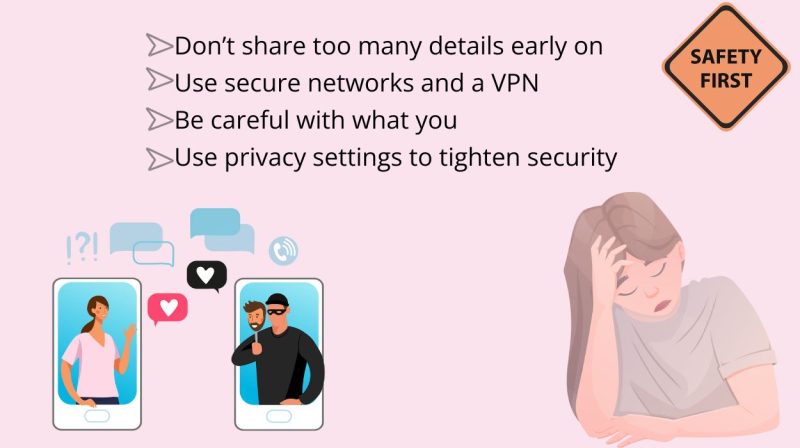
- Tell a parent or trusted adult which apps you’re using. Not the full content of every conversation. Just that you’re on the platform
- Never share your home address, school name, phone number, or last name with someone you’ve only met online
- Turn off location services for dating apps, or set them to approximate rather than exact
- If you decide to meet someone in person, do it in a very public place and tell at least one person exactly where you’re going. This is the same advice that applies across all online dating. Check our guide on online dating tips for the full picture
- Look for synced social media profiles to check whether someone is who they claim to be. A profile with no other online presence is a warning sign
- Report and block any profile that makes you uncomfortable. You don’t owe anyone an explanation
- Trust your instincts. If a conversation feels off, it probably is. That gut check is one of the simplest ways to spot catfishing before it goes further.
FAQs
Yubo and Spotafriend are the most consistently recommended options for users aged 13+. Both separate teen and adult communities, use some form of age verification, and have active content moderation. Spotafriend is strictly limited to ages 13–19, so there’s no possibility of adult users in the pool. Neither is entirely without risk, but both invest significantly more in safety infrastructure than any alternative on this list.
No platform is completely risk-free. Apps with the strongest safety records — Yubo, Spotafriend, BeFriend — invest in age estimation, content moderation, and separate teen and adult environments. Apps with the weakest records — Kik, Wizz — have minimal age verification and lower content oversight. Safety also depends significantly on how the app is used: whether location services are on, what personal information is shared, and whether a trusted adult is aware the teen is using it.
Tinder’s minimum age is 18. A 16-year-old can technically access it by entering a false birthdate, but Tinder provides no safety infrastructure for users under 18. The adult user pool is unfiltered, there’s no teen-specific content moderation, and the risk level is substantially higher than on any dedicated teen platform.
Beyond dedicated teen dating apps, teenagers frequently use Snapchat DMs, Discord servers, TikTok comments, and Instagram DMs to connect romantically. They also access adult apps like Tinder and Bumble by entering a false birthdate. The answer to “what apps is my teen using to meet people?” is often not a dedicated dating app at all.
The main risks are contact with adults who misrepresent their age, sextortion, location exposure through default app settings, and the mental health impact of appearance-based matching on developing self-esteem. These risks vary significantly by platform. The Risks section earlier in this article covers each in detail.
The most common method is entering a false birthdate during sign-up. Almost no app currently cross-references that against any external source. Yubo and a small number of other platforms use facial age-estimation at sign-up, which is more robust, but it remains the exception rather than the standard.
Start with a calm conversation rather than immediate punishment. What app is it, who are they talking to, and do they know how to handle uncomfortable situations? If the app carries genuine safety risks, for example, Kik, adult apps accessed with a false age, explain specifically why it’s a problem rather than just issuing a ban. The goal is a teenager who comes to you when something goes wrong, not one who hides things more carefully.
No platform is dedicated exclusively to LGBTQ+ teens, but several are notably inclusive. Teen Chat has a long-standing reputation as a welcoming community for LGBTQ+ users. BeFriend includes identity-affirming design. CrushZone explicitly welcomes users of any sexual orientation. For LGBTQ+ teens in less accepting communities, these platforms can provide meaningful connection that isn’t available locally.
Yubo is one of the safer options for a 14-year-old relative to everything else on this list. It requires parental permission for under-18 accounts, separates teens from adults, and uses age-estimation and face recognition at sign-up. Parental awareness and open communication still matter. Knowing your teen is on Yubo and checking in on their experience is more effective than either banning it outright or stepping back entirely.
The distinction is often cosmetic. Yubo calls itself a social discovery platform. Spotafriend markets itself as a friend-making app. Wizz positions itself as a social network. In practice, teenagers use all of these for the same purposes: meeting new people, and sometimes dating them. The label matters less than the safety features, age verification rigor, and content moderation policies of the specific platform.
Final Thoughts
The drive for connection is developmentally normal at every age in this range. Teenagers have always found ways to meet people outside their immediate circle. What’s changed is that the circle now extends globally, and the safety infrastructure has struggled to keep pace with that scale.
If you’re a teen reading this, the apps above are your best starting point for exploring online connection safely. Use the comparison table to find one that suits your age and what you’re actually looking for. Set your location to approximate. Don’t share personal details until you’ve had enough conversations to feel genuinely confident about who you’re talking to. And remember that the most reliable signal you have is your own instinct. If something feels off, it usually is.
If you’re a parent, the goal isn’t to prevent your teenager from ever thinking about dating. It’s to help them navigate those feelings in ways that don’t put them at risk. That means ongoing conversations, not just a one-time talk. It means being the kind of parent they come to when something feels wrong, rather than the one they hide things from. And it means accepting that you can’t control everything but you can equip them with better judgment than they’d arrive at on their own.
The safest teens on these platforms aren’t the ones on the safest apps. They’re the ones with a trusted adult who knows which apps they’re on and a clear sense of what they’d do if something went wrong. That’s worth more than any content moderation system any platform has built.
The 13 Types Of Crushes You Have Had (Or Will Have) At Least Once!
9 Worrying Signs A Cyberstalker Likes You And How To Protect Yourself
Your contribution does not constitute a charitable donation. It will allow Bonobology to continue bringing you new and up-to-date information in our pursuit of helping anyone in the world to learn how to do anything.
















Report an Error
Helpful