

The ‘infatuation vs love’ debate is one that’s been going on since time immemorial. People often confuse signs of infatuation with love as both the feelings lead to similar behaviors, at least in the beginning. However, there is one major difference between both — infatuation is temporary while love is permanent.
But if both feel similar, how do you tell which is which in the beginning? To answer this, we need to understand what infatuation is. We talked to Psychologist Nandita Rambhia (MSc, Psychology), who specializes in CBT, REBT, and couples counseling, to help shed light on the topic.
Definition: Infatuation is an intense, short-lived attraction fueled by chemistry, fantasy, and desire rather than genuine emotional connection.
Brain Chemistry: High dopamine and adrenaline create thrill and craving; serotonin dips cause obsessive thinking; oxytocin rises later if attachment develops.
Duration: Typically lasts 6–18 months, sometimes up to 2 years before mellowing or transforming into love.
Key Signs: Constant preoccupation, idealizing your partner, needing reassurance, ignoring red flags, and emotional highs and lows.
What Is Infatuation?
Table of Contents
Infatuated love consists of strong feelings of attraction for someone or something, which do not last very long. One of the clearest signs of infatuation is that you lose feelings over time.
“Infatuation occurs when a person feels intense attraction, admiration, or sexual passion toward someone else. You will notice physical symptoms of it such as butterflies in your stomach, being sweaty, and a rise in your heart rate in their presence. Our brains release a whole mix of chemicals and hormones that cause all these feelings surrounding infatuation. It also leaves us incapable of thinking clearly.”
Nandita Rambhia, Psychologist

These short-lived feelings tend to make you obsessed with the person.
- Everything about them seems perfect
- It feels like you have found the one for you
- Their mere presence fills up your world with smiles that don’t go away
- You are always daydreaming of a perfect happily-ever-after with them
When asked, “What does infatuation feel like?, this reddit user beautifully described the difference between infatuation and love. “Infatuation: oh I really like this person so much I can’t even see his/her flaws. Love: I fully know this person, down to his/her biggest flaws, and I still want to be with him/her.”
Related Reading: Love Vs Attachment: Is It Real Love? Understanding The Difference
What Causes Infatuation?
If you often find yourself asking, “Am I in love or infatuated?”, you are not alone. Many people confuse feelings of infatuation for love. To be able to differentiate infatuation vs in love, let’s first identify the causes of infatuation.
Here are some causes of infatuation listed by Nandita:
1. Insecurity and low self-esteem
When self-worth depends on external validation, even small doses of attention can feel intoxicating. The affection of a desired person temporarily fills an internal void, making their approval feel like oxygen. Psychologists call this validation-driven attachment, where attraction functions as self-soothing rather than connection.
2. Past trauma or emotional neglect
People who grew up feeling unseen or emotionally deprived may unconsciously chase intensity as proof of importance. Infatuation mimics safety through passion: it provides emotional “noise” that distracts from old wounds. This is why trauma survivors sometimes mistake anxiety for chemistry.

3. Loneliness and unmet emotional needs
Prolonged loneliness or lack of intimacy can heighten the brain’s reward response when someone new shows interest. Studies show that oxytocin and dopamine surge more strongly when a person experiences novelty after social isolation, amplifying infatuation.
4. Fantasy and idealization
The mind often edits reality. We build mental stories that can turn admiration into obsession. This idealization bias projects our own hopes and unresolved desires onto someone else, often ignoring clear incompatibilities.
The chemical reaction in your brain is going to make you feel like you’re falling in love too fast, but these could just be signs of infatuation. What you’re probably feeling is infatuated love, not the true or genuine kind.
Neurochemistry and hormones involved
Serotonin: Paradoxically, people in early infatuation often show reduced serotonin, which is theorized to underlie obsessive thinking. Some studies compare new lovers’ serotonergic profiles to those with obsessive-compulsive disorder
Dopamine: Dopamine is central to the “seeking” or reward motivation system. In early romantic attraction, dopaminergic pathways become highly active. In one study, people in early-stage attraction showed activation in brain areas related to reward and motivation
Norepinephrine: Because infatuation is partly stressful, cortisol levels may also rise, contributing to alertness and obsessive focus.
What Is Love?
When it comes to love, things go a little differently. Here’s are some characteristics of love as per Nandita:
- Love doesn’t fade even when you have been in a relationship with someone for years
- Your partner’s quirks and flaws don’t bother you, in fact, those are things you learn to love about them
- Love goes way beyond physical appearance
Now, I know there are several questions popping up in your mind. What does infatuation feel like? Can infatuation turn into love? You’ll find all the answers here. But first, let’s discuss the difference between infatuation and love in detail.
Sternberg’s Triangular Theory of Love
Over time, relationships that succeed tend to develop intimacy and commitment to form consummate love
Robert Sternberg’s model posits three components of love: Passion, Intimacy, and Commitment. Infatuation largely emphasizes passion with little intimacy or commitment
Related reading: Am I in love with my best friend? What should I do?
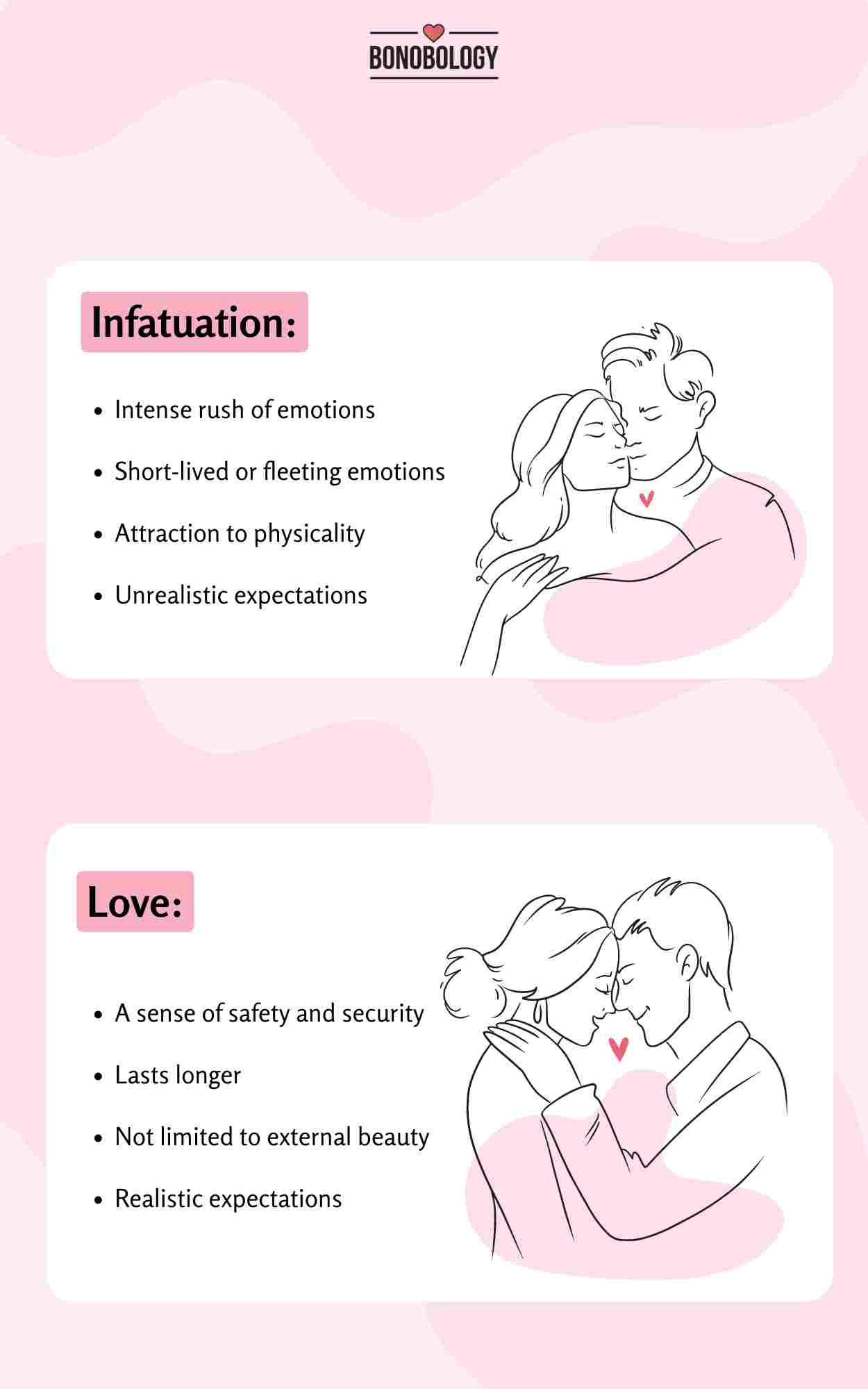
Difference Between Infatuation And Love
While both are two different emotions, it’s possible to mistake one for the other because the feelings are so intense. When you are infatuated with a person, the attraction is so powerful that you feel like you’re in love or at least, want that to be the case.
However, infatuation often takes place with an idealized perception of the person and not their actual personality. Let’s understand the difference between love and infatuation so that you can get a better grip on what you are feeling.
12 Clear Signs Of Infatuation That Are Mistaken For Signs Of Love
Now that we’ve discussed infatuation meaning and its causes, let’s discuss some infatuation signs. As established already, it is not uncommon to confuse infatuation or love. In fact, a lot of serious relationships do start with infatuation. Hence, identifying the signs of infatuation is not that simple.
“Love sees clearly, and seeing, loves on. But infatuation is blind; when it gains sight, it dies. -Mary Roberts Rinehart”
Infatuation is short-lived but intense. In this period, your feelings cloud your judgment. Until, one day, you realize that the lovey-dovey feelings have suddenly dissipated.
Here are 12 signs of infatuation that can be confused with love:
1. You put them on a pedestal
This is one of the biggest signs of infatuation in a girl or boy. You idolize them as if they are some kind of legend or prize and you keep telling yourself that you’re lucky to be with them.
Love is when you go past this initial puppy love phase and come back to reality where you see the real person for who they are and accept them wholeheartedly. But until then, what you feel is just a magnetic attraction.
“As spellbinding as it may be, once the glass of ‘perfection’ shatters in infatuated love, you lose interest in the person as quickly as you developed it in the first place. After this, you can never look at them with the same level of awe.”
– Nandita Rambhia, Psychologist
2. You don’t feel like getting to know the person
Another one of female or male infatuation signs is making up an idealized version of the person in your head rather than getting to know their real personality.
- Your conversation with them is filled with superfluous flirting and nothing substantial
- When you are attracted to someone, you feel like you know this person because you have created the perfect version of them in your head.
- As you don’t want to ruin your flawless idea of them, you don’t even make the effort to dig deep and get to know the real person.
Related Reading: Insecurity In A Relationship: Causes, Signs, Way To Cope
3. You start acting desperate
One of the unmissable signs of infatuation is desperation. In infatuation, every feeling is heightened to such an extent that you want things to accelerate as quickly as possible. This desperation is more commonly seen in insecure women and men.
“Thinking that the person is almost perfect, is one of the clear infatuation symptoms. One only sees the positives in them and only focuses on what one likes about them. You will dismiss their negative points because of this intense admiration. Due to such idealistic notions, you tend to become needy almost to a point where you would be willing to do anything for them.”
Nandita Rambhia, Psychologist
On the contrary, in love, you take one step at a time. You don’t feel the need to rush because you know you are together.
4. Flirting too much is one of the signs of infatuation
Your conversations can’t be called ‘actual conversations’ because they are essentially centered on flirting.
- Almost every conversation includes both of you flirting incessantly and complimenting each other non-stop. It is as if there is nothing else to talk about. Because that’s the truth: there is nothing else to talk about. This is an absolute sign of mutual infatuation.
- When in love, you can find affection even in the most boring conversations. You may be talking about laundry and still tell yourself, “Wow, I love this person so much!”
Yes, it is healthy to flirt in a relationship but only to a certain point. If you’re wondering, “Am I in love or infatuated?” Think about what happens when you have to talk about things that are mundane things, like your daily routine. If these things are of no interest to them or you, it is probably infatuation that you’re experiencing.
Related Reading: 10 Telltale Signs You Are Not Ready For A Serious, Committed Relationship
5. It’s all going too fast
It seems as if you are in a rush and can’t wait to take your relationship to the next level. This is one of the signs of infatuation in a girl or boy.
- The dopamine prevents you from objectively analyzing if the person is even a good match for you.
- You don’t want to think about facts or reason because that might make you realize that this is not the right person for you.
6. Not acting like yourself is a sign of infatuation
“When infatuated with someone, you want to impress that person by any means. You don’t act like your normal self, but portray a version of yourself that they would like and enjoy.”
– Nandita Rambhia, Psychologist
Not being yourself or doing things to impress someone can work out for you for a while but is never sustainable. When, in every moment, you start to worry that revealing your true self will threaten your relationship, it is a sign of infatuation. It will make you anxious and worried that the moment they know the real you, they will walk out of your life.
Related Reading: 5 Ways Being Honest With Yourself Will Help You Understand Your Relationship Better
7. Lust overpowers other emotions
One of the signs of infatuation in a guy or a girl is that they care about sex far more than they care about you. So it’s time to ask yourself whether you feel love or lust for them.
- What is the first feeling that you get when you see your partner?
- Do you want to make out with them or rope them into a long hug first?
- Is the sexual tension palpable?
Infatuation makes you more sexually attracted to a person than wanting to spend quality time with them. If you feel like the only things you want to do with your partner are of a sexual nature, know that it is one of the signs of infatuation.

8. You want everything to be perfect in your world
One of the infatuation symptoms include creating a perfect relationship in your head, devoid of any
- Flaws
- Disagreements
- Compatibility issues
You’re willing to neglect or ignore anything that threatens this fairy tale of yours.
This prevents you from seeing your partner’s flaws or red flags and taking the necessary action to protect yourself from heartbreak.
9. You are starting to lose interest
It has not been long since your relationship began and you are already getting bored of what the two of you have.
- Things you once liked about the person are no longer appealing to you
- Those butterflies you used to get earlier are nowhere to be seen or felt anymore
- You realize that you’re starting to lose interest in them
Your partner is getting comfortable around you and might even be falling in love with you. But them portraying their true self and opening up to you is just not appealing to you anymore. It is definitely not what you had expected but it is happening.
Related Reading: 7 Things To Do When You Fall Out Of Love With Your Husband
10. You start feeling alone
As time goes by and the initial physical fizzles out, you notice a lack of emotional connection with your partner. This distance or complacency in a relationship is one of the signs of infatuation.
- They don’t feel like your safe space or a shoulder to cry on, and you aren’t theirs
- You start feeling lonely even though you are in a relationship
- You can’t rely on your partner in tough times because there was never any understanding or love in your relationship, to begin with.
Now that you know that, you feel distant from them and are unwilling to open up.

11. You do whatever they tell you to do
It will seem as if all your senses have stopped working and that itself is the biggest sign that you are not in love.
- Love can enrapture you, but it shouldn’t make you act crazy. On the other hand, infatuation can
- When you are infatuated with someone, you do not want to disappoint them. You tend to do whatever they tell you to
- Your brain is working toward a singular objective: impressing your partner and making them love you. You do not question their ways.
- If they are abusive, controlling, obsessive, neglectful, or clingy toward you, it just doesn’t register. You are so infatuated with them that you look the other way and, therefore, choose to ignore all the relationship red flags.
12. You are delusional
Finally, it’s important to say this one out loud:
- You think that you are in love, but in reality, it’s merely an intense attraction topped with lust
- You don’t think straight, you are simply unable to.
- The infatuation just keeps making you dive deeper into your delusions, making you think of this perfect life with the perfect person that does not even exist outside of your own head.
“For a short period of time, one is prey to an illusion of perfectionism in another person. One wants the fantasy to continue as they avoid looking at the mundane, the ordinary, and even the red flags in that person.”
– Nandita Rambhia, Psychologist
If you’re oblivious to or delusional about your partner’s ways, know that you are in an infatuation relationship.
Cognitive biases and idealization
- Intrusive thinking: the beloved occupies a disproportionate share of mental space; studies show people in romantic love spend ~67% of their thoughts thinking about their beloved; in tasks, that focus distracts performance.
- Selective attention/confirmation bias: infatuated individuals tend to notice only attractive traits, ignore flaws, and interpret ambiguous behavior in favorable light
- Projection/idealization: This includes projecting desires/fantasies onto the other, seeing them as “perfect,” or attributing own ideal traits
- Memory bias / positivity bias: exaggerating positive experiences, forgetting negatives.
Related Reading: 10 Reasons He Suddenly Stopped Chasing You – Even When You Wanted Him To
How Long Does Infatuation Last?
IInfatuation feels endless at first, but neuroscience paints a different picture.
According to multiple studies, the infatuation phase typically lasts between 6 and 18 months, sometimes stretching up to two years.
When it fades
As novelty declines and real-life patterns set in, dopamine activity drops. The intense highs become steadier or vanish altogether. This is not failure, it’s biology adjusting from “seeking mode” to equilibrium.
When it evolves into love
If mutual vulnerability, trust, and consistent emotional support develop during this phase, infatuation can transition into mature attachment.
This happens when:
- Both partners gradually reveal their real selves
- Conflicts are handled with communication, not panic
- Emotional needs are met through trust, not thrill
“Infatuation is normally short-lived, but it could indeed last anywhere from one month to three years, even in an LDR. It occurs when we still don’t know a person well enough and choose to be smitten with only the side of them we do know. But when you meet the person often and understand other dimensions of their personality, the infatuation slowly reduces.”
– Nandita Rambhia, Psychologist
Turning infatuation into a deeper connection
Infatuation can be the spark; love is the slow burn that sustains. To let it evolve rather than implode:
- Replace fantasy with curiosity: Ask real questions, not idealized ones
- Cultivate emotional safety: Share insecurities honestly; listen without judgment
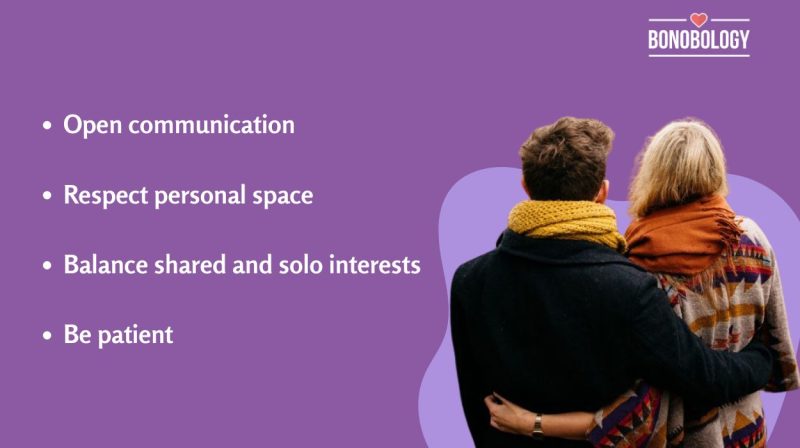
- Balance individuality and intimacy: Love grows when two whole people choose each other repeatedly, not when one person fills another’s emptiness
- Be patient: True connection unfolds with time, conflict, and trust, not constant excitement
Many studies estimate infatuation/passionate love phase lasts about 6 to 18 months, while some may extend to 2 years, or even up to 3 years) before declining
Risks And Pitfalls Of Unchecked Infatuation
Infatuation can be beautiful but without awareness, it can become emotionally costly. Here’s are some of the risks of getting highly infatuated with someone:
1. Obsessive thinking
Infatuation hijacks the brain’s reward system much like an addictive substance. Dopamine surges when you anticipate contact, and cortisol spikes when you don’t hear from them. This constant chemical loop fuels rumination and makes you emotionally unstable.
How it shows up
- You replay conversations and analyze every word or emoji, searching for hidden meaning
- You refresh messages or social media repeatedly to see if they’ve viewed or responded
- Even during work, meals, or sleep, thoughts of them intrude uninvited; what neuroscientists call intrusive romantic cognition
- You experience temporary relief after receiving attention, followed by craving when communication pauses
- You may even fantasize future scenarios like vacations, marriage, moving in despite knowing little about them
Why it happens
The brain releases dopamine for anticipation, not satisfaction, so the more uncertain or unavailable they are, the more addictive the infatuation becomes.
Related Reading: Panromantic: What Does It Mean to Be One?
2. Emotional distress
Infatuation feels euphoric at its peak and unbearable when it dips. The brain alternates between dopamine highs and cortisol-driven lows, creating a push-pull emotional rollercoaster.
Typical emotional patterns
- Euphoria when they text, compliment, or show affection
- Anxiety or sadness when they withdraw or delay a reply, triggering fear of rejection
- Your self-worth fluctuates based on their attention or availability
- Physical symptoms include racing heart, loss of appetite, difficulty concentrating, and disturbed sleep
- Minor misunderstandings feel catastrophic, leading to rumination, guilt, or panic
3. Ignoring red flags
Infatuation clouds judgment by idealizing the person instead of perceiving them accurately. The need to preserve fantasy overrides logic, leading you to minimize or rationalize warning signs.
Common red-flag dismissals
- Incompatibility denial: Convincing yourself “we’re just different” instead of acknowledging conflicting values or life goals
- Boundary erosion: Tolerating disrespect, inconsistency, or emotional unavailability to keep the connection alive
- Selective attention: Focusing only on their charm or chemistry, ignoring instability or manipulation
- Excuse-making: Attributing poor behavior to stress, “past trauma,” or your own mistakes
- Ignoring intuition: A quiet inner discomfort dismissed as overthinking or “being dramatic”
Psychological root
This stems from idealization bias; your brain literally filters information to protect the illusion of perfection, prioritizing reward over realism.
Related Reading: Your Go-To Guide for Finding Profiles on Tinder
4. Unhealthy sacrifice
When infatuation dominates your emotional world, balance and identity begin to erode. The desire to maintain closeness outweighs self-care and personal boundaries.
Typical behavioral sacrifices:
- Neglecting hobbies or passions: Giving up creative outlets or fitness routines to stay available for them
- Social withdrawal: Spending less time with friends and family who might question the relationship’s intensity
- Work and focus decline: Losing productivity because your attention stays emotionally tethered elsewhere
- Self-neglect: Disrupted eating, poor sleep, or ignoring personal needs to accommodate their schedule
- Financial or time overextension: Excessive gifting, traveling, or rearranging commitments for minimal reciprocity
Long-term effect:
When the infatuation fades, people often feel empty, depleted, or resentful, realizing they invested energy into an illusion rather than mutual growth.
| Signs | Infatuation | Love |
| Emotional | Feels exhilarating but fragile. Mood swings depend on attention or reciprocation. | Feels steady and emotionally secure, even during conflict. |
| Cognitive | Driven by fantasy and projection; ignores flaws. | Realistic evaluation; accepts partner’s strengths and weaknesses. |
| Behavioral | Impulsive texting, obsessive checking, prioritizing appearance or approval. | Consistent care, empathy, and mutual support. |
| Physiological | Fast heartbeat, insomnia, appetite loss, restlessness, “butterflies.” | Physiological calm; comfort and trust in proximity. |
| Attachment Style | Stronger in people with anxious-preoccupied attachment; quick emotional dependency. | Healthy balance in secure attachment. |
| Duration | Intense but temporary; 6-18 months on average. | Strengthens with shared experiences; can last decades. |
| Motivation | Desire to possess, to be desired, or to fill emotional void. | Desire to nurture, protect, and grow together. |
| Conflict Response | Prone to jealousy, overreaction, withdrawal. | Uses communication and repair attempts. |
FAQs
No, there is nothing wrong with infatuation. In fact, most of us get infatuated at some point in our life. It’s the most normal thing. At times, infatuated love leads to real love. It can get toxic and unhealthy if taken to an extreme level. But, otherwise, it is the first step to getting to know someone intimately.
An infatuation lasts anywhere between six months to three years. It could turn into a more serious relationship if it lasts beyond that. But people do realize even after a year that they are infatuated and it is not love. It can last longer if it’s a long-distance relationship.
What starts as infatuation can turn into love. Infatuation typically starts with sexual or physical attraction. It’s the physical aspect that keeps the relationship going, but sometimes mutual infatuation can turn into mutual love. Having said that, it is also possible for an infatuation to not turn into love if the person does not reciprocate their partner’s feelings or live up to their idea of a perfect partner.
As we mentioned above, if you show signs of infatuation — like you are too physical, too desperate, you feel overpowering lust, and you don’t want to look beyond the superficial things — then it’s not love. If you are in love, you will look at your relationship from a deeper perspective. You will want to savor every moment of it and take things slow.
Key Pointers
- While infatuation and love seem similar, they are completely different feelings
- Infatuation is temporary and superficial. Love is permanent and involves elements beyond physical appearance
- How long does infatuation last? As long as you give in to the delusion and don’t see the situation objectively
- While infatuation can sometimes turn to love, it is not guaranteed
Final Thoughts
Infatuation and love can often feel similar. Love is supposed to last a lifetime while infatuation is short-lived. When infatuated, you tend to focus on the physical attributes and lust is the overpowering emotion. While infatuation can turn into love, that is not always the case and thus, you should not always get your hopes up.
Your contribution does not constitute a charitable donation. It will allow Bonobology to continue bringing you new and up-to-date information in our pursuit of helping anyone in the world to learn how to do anything.







Featured
How Mutual Respect Influences Relationship Satisfaction
Why Cross-Cultural Relationships Are Growing
Dating While Pregnant: Complete Guide to Healthy, Respectful Connections
Good Rizz Lines For A Girl: Best Flirty, Smooth And Funny Lines That Work
Introvert Dating: A Complete Guide (2026)
The Role of Trust in Relationships: How to Build and Maintain It
5 Communication Styles In Relationships: What They Mean & How To Use Them
21 Nuggets Of Relationship Advice For Women
What Is Simping And Is It A Red Flag In Guys?
Introvert Dating Introvert: A Complete Guide
Is He Shy Or Not Interested? 26 Ways To Tell The Difference
Gen Z Dating: Understanding and Navigating the Landscape
What Are Fun Dating Questions? 140 Playful, Flirty, and Deep Starters
Navigating Exclusivity In A Relationship: How To Do It Right
Do Girls Like Shy Guys? 7 Reasons They Do
101 Fun Date Night Questions To Laugh, Flirt, And Bond Over
161 Weird Questions To Ask Your Boyfriend And Get Him Talking
Why I Will Never Date A Widower Again -A Woman’s Story
How Long Should You Date Before Getting Engaged
Dating Guide: 9 Things To Never Do In The First Month Of Dating