

| Key Pointers • Infatuation feels intense but temporary, while love is calmer and built to last. • Brain chemistry drives the highs of infatuation: dopamine and adrenaline create the rush, while dipping serotonin fuels the obsessive thinking. • The clearest signs of infatuation are constant preoccupation, idealizing your partner, ignoring red flags, and needing constant reassurance. • Infatuation typically lasts six to eighteen months, sometimes stretching to two years, before it fades or matures into love. • It can evolve into real love, but only if both people choose honesty over fantasy. That outcome is never guaranteed. |
People have been having the infatuation vs love debate since long before anyone had a word for either feeling. Both show up looking almost identical at first. A racing heart, constant texting, the conviction that you have finally found someone extraordinary. But one of these feelings fades. The other one doesn’t.
Here’s the one-line version: infatuation is temporary, love is permanent. In this article, we help you tell which one you’re actually standing in. To get this right, we spoke with psychologist Nandita Rambhia (MSc Psychology), who specializes in CBT, REBT, and couples counseling.
“Infatuation occurs when a person feels intense attraction, admiration, or sexual passion toward someone else. You will notice physical symptoms of it, such as butterflies in your stomach, sweating, and a rise in your heart rate in their presence. Our brains release a mix of chemicals and hormones that cause these feelings. It also leaves us incapable of thinking clearly.
Nandita Rambhia, Psychologist
One of the clearest signs of infatuation is that the feeling fades on its own timeline, whether or not the relationship does anything wrong. Recognizing that pattern early is most of the battle.
What Is Infatuation?
Table of Contents
Infatuated love is a burst of strong attraction that arrives fast and doesn’t last very long. Everything about the person feels perfect, their presence lights up a room, and you may feel like you’ve found the one within weeks of meeting them. You daydream about a future you haven’t earned yet.
A well-known description from an online relationships forum sums up the contrast neatly: infatuation means you can’t see the other person’s flaws, while love means you know their flaws in full and still choose to stay.
Related Reading: Love Vs Attachment: Is It Real Love? Understanding The Difference
What Causes Infatuation?
If you keep asking yourself whether what you feel is love or infatuation, you’re not alone. Here are the roots Nandita points to most often.
1. Insecurity and low self-esteem

When your sense of worth depends on someone else’s approval, even small amounts of attention can feel intoxicating. Their affection temporarily fills a gap that has nothing to do with them. Psychologists call this validation-driven attachment: the attraction is doing the work of self-soothing, not connection.
2. Past trauma or emotional neglect
People who grew up feeling unseen sometimes chase intensity because it reads as proof that they matter. Infatuation can mimic safety through sheer passion, drowning out older wounds with noise. This is one reason trauma survivors sometimes mistake anxiety for chemistry.
Related Reading: Insecurity In A Relationship: Causes, Signs, Way To Cope
3. Loneliness and unmet emotional needs
Extended loneliness can heighten the brain’s reward response the moment someone new shows interest. When novelty follows a stretch of isolation, dopamine and oxytocin tend to surge harder, amplifying whatever you’re already feeling.
4. Fantasy and idealization
The mind edits reality. We write mental scripts that quietly turn admiration into obsession, projecting our own hopes onto someone we barely know while ignoring the parts of them that don’t fit the story.
The chemical reaction happening in your brain can make you feel like you’re falling in love too fast, when what you’re actually feeling is infatuation rather than the real thing.
Neurochemistry and hormones involved

Serotonin: People in early infatuation often show reduced serotonin, which is theorized to underlie the obsessive, looping thoughts. Some studies compare new lovers’ serotonin profiles to those seen in obsessive-compulsive disorder.
Dopamine: Dopamine drives the brain’s “seeking” system. In early romantic attraction, dopaminergic pathways light up hard. One study found that people in early-stage attraction show activation in the same brain regions tied to reward and motivation.
Norepinephrine: Because infatuation carries a real stress component, cortisol can rise too, adding to the alertness and the obsessive focus.
What Is Love?
Love behaves differently, according to Nandita’s characteristics of love:
- It doesn’t fade after years together, it settles
- Your partner’s quirks and flaws stop being obstacles and start being things you’re fond of
- It goes well beyond how someone looks
Psychologist Robert Sternberg’s Triangular Theory of Love breaks the emotion into three components: passion, intimacy, and commitment. Infatuation runs almost entirely on passion, with little of the other two. Relationships that last tend to build all three over time, forming what Sternberg calls consummate love.
Related Reading: Am I In Love With My Best Friend? What Should I Do?
Difference Between Infatuation And Love
Both feelings are intense enough that it’s easy to mistake one for the other, especially early on. When you’re infatuated, the pull can feel so strong that you convince yourself it must be love, partly because you want it to be.
The real difference sits in what the attraction is built on. Infatuation runs on an idealized version of a person, not who they actually are. Working through the difference between love and infatuation is the fastest way to get honest with yourself about what you’re feeling.
Related Reading: 6 Signs Of True Love: Learn What They Are
12 Clear Signs Of Infatuation That Are Mistaken For Signs Of Love
A lot of serious relationships do start out as infatuation, which is exactly why picking infatuation apart from the real thing isn’t as simple as it sounds. Novelist Mary Roberts Rinehart put it well: love sees clearly and keeps loving, while infatuation is blind, and dies the moment it starts to see. Infatuation is short and intense, clouding your judgment until, one day, the lovey-dovey feeling is just gone. Here are 12 signs of infatuation that regularly get confused with love.
1. You put them on a pedestal
You idolize them like they’re a prize you got lucky to win. Love happens once you move past this initial puppy love phase and come back down to see the real person, flaws included, and choose to accept them anyway. Until then, what you’re feeling is closer to a magnetic attraction than genuine intimacy.
“As spellbinding as it may be, once the glass of perfection shatters in infatuated love, you lose interest in the person almost as quickly as you developed it in the first place. After that, you can never look at them with the same awe again.
“Nandita Rambhia, Psychologist
2. You don’t feel like getting to know the person
You’ve built an idealized version of them in your head instead of learning who they actually are.
- Your conversations are full of flirting and light on substance
- Feeling deeply drawn to someone can trick you into believing you already know them, because you’ve filled in the gaps yourself
- You avoid digging deeper because you don’t want to disturb the flawless picture you’ve built
Example: You’ve been talking for weeks but couldn’t say what their actual career goals are, only that they’re “amazing.”
Related Reading: How Do You Know You Love Someone, 11 Signs That Say So
3. You start acting desperate
Every feeling gets turned up so high that you want the relationship to move faster than it should. This kind of desperation shows up more often in insecure women and men alike.
“Thinking the person is almost perfect is one of the clearest infatuation symptoms. You only see the positives and dismiss anything negative because the admiration is so intense. That idealizing tends to make people needy, almost to the point of being willing to do anything for the other person.
“Nandita Rambhia, Psychologist
In love, you take one step at a time. There’s no rush because you already know you’re in it together.
4. Flirting too much is one of the signs of infatuation

Your conversations barely qualify as conversations because they’re built entirely around flirting.
- Every exchange is compliments and banter on repeat because that’s genuinely all there is to talk about right now
- In love, you find affection even in boring conversations. You can talk about laundry and still think, “I really love this person.”
There’s nothing wrong with healthy flirting in a relationship, up to a point. Ask yourself what happens when the topic turns mundane, like your daily routine. If neither of you has anything to say once the flirting stops, that’s a sign of infatuation rather than love.
Related Reading: 10 Telltale Signs You Are Not Ready For A Serious, Committed Relationship
5. It’s all going too fast
You feel rushed, unable to wait to take things to the next level. Dopamine is part of why: it keeps you from objectively weighing whether this person is actually a good match, because slowing down might mean admitting they aren’t theright person for you.
Example: You’re discussing moving in together after six weeks, before you’ve met each other’s friends.
6. Not acting like yourself is a sign of infatuation
“When you’re infatuated with someone, you want to impress them by any means necessary. You stop acting like your normal self and start performing a version of you that you think they’ll like.
“Nandita Rambhia, Psychologist
This can work for a while, but it’s never sustainable. If you’re constantly worried that showing your real self will end things, that’s a sign of infatuation. It keeps you anxious, bracing for the moment they meet the actual you and leave.
Related Reading: 5 Ways Being Honest With Yourself Will Help You Understand Your Relationship Better
7. Lust overpowers other emotions
One of the more obvious infatuation symptoms in a guy or a girl is caring more about sex than about the person. Ask yourself what you actually want when you see your partner. A long hug, or something else? Is the sexual tension the main thing keeping the relationship interesting?
Infatuation tends to make you more drawn to a person physically than to spending unstructured time with them. If sex is the only thing you actually want to do together, that’s a sign of infatuation worth paying attention to.
Example: You’d rather stay in than go on a low-key date, because the date doesn’t guarantee the physical part.
8. You want everything to be perfect in your world

You’ve built a relationship in your head with no flaws, no disagreements, and no compatibility issues, and you’re willing to ignore anything that threatens that fantasy. This keeps you from noticing your partner’s actual red flags in time to protect yourself.
9. You are starting to lose interest
It hasn’t been long, and you’re already bored.
- The things you once liked about them have stopped feeling special
- The butterflies are gone
- You notice yourself pulling away
Meanwhile, your partner may be getting more comfortable and even falling in love with you, opening up in ways that used to excite you and now just feel ordinary. That mismatch is a strong sign of infatuation on your end rather than love.
Related Reading: 7 Things To Do When You Fall Out Of Love With Your Husband
10. You start feeling alone
As the initial spark fades, you notice a gap where emotional connection should be. This complacency is one of the quieter markers of infatuation.
- They don’t feel like a safe space, and you’re not one for them either
- You feel lonely inside a relationship that’s supposed to be the opposite of lonely
- You can’t lean on them in hard moments, because there was never real understanding underneath the attraction
11. You do whatever they tell you to do
It’s as if your judgment has switched off entirely, and that alone should tell you something.
- You avoid disappointing them at almost any cost, doing whatever they ask
- Your focus narrows to one goal: impressing them and keeping their interest
- If they’re abusive, controlling, or neglectful, it doesn’t register because you’re too invested to notice the relationship red flags in front of you
12. You are delusional
Say it plainly: what feels like love may just be intense attraction with lust layered on top. You’re not thinking clearly, and part of you knows it. Infatuation keeps pulling you deeper into a fantasy about a perfect life with a person who, outside your head, doesn’t quite exist.
“For a short period, a person becomes prey to an illusion of perfection in someone else. They want the fantasy to continue, so they avoid looking at the mundane, the ordinary, and even the red flags.
“Nandita Rambhia, Psychologist
Cognitive biases behind the idealization
- Intrusive thinking: The person you’re infatuated with takes up a disproportionate share of your mental space, often at the cost of focus on work or other relationships.
- Selective attention: You notice only their attractive traits and read ambiguous behavior in the most favorable light possible
- Projection: You assign them qualities and desires that are really your own, then fall for the version you built
- Positivity bias: You remember the good moments in vivid detail and let the bad ones blur
Related Reading: 10 Reasons He Suddenly Stopped Chasing You, Even When You Wanted Him To
7 Signs You’re In Love, Not Just Infatuated
If the list above sounded familiar, this next one is the other half of the answer. This is genuinely the part most infatuation articles skip: what does the real thing actually look like, side by side with the fake one? Here’s how to know if you’re in love, based on patterns that hold up once the initial rush wears off.
1. You feel calm, not just excited

Infatuation runs hot. Love runs steady. You still feel a spark, but it doesn’t come with the constant low hum of anxiety about where you stand.
Example: You don’t panic when they take a few hours to text back, because you trust the relationship isn’t riding on one reply.
2. You know their flaws and you’re still in
You’ve seen them at their worst, tired, unreasonable, or in a bad mood, and none of it changed how you feel.
Example: You know they leave dishes in the sink for days, and it mildly annoys you, but it’s not a dealbreaker.
3. You want them to do well, even without you
Their success doesn’t threaten you. You’re glad when they win, whether or not you’re in the room for it.
Example: You’re genuinely thrilled when they get a promotion that means longer hours and less time with you.
4. Mundane moments feel fine
You can talk about chores, bills, or nothing at all and still feel connected, because the emotional needs in the relationship are being met beyond the highs.
5. You picture a real future, not just the next date

You talk about next year, not just next weekend. Love looks past the moment. Infatuation rarely gets past this weekend.
Example: You’ve discussed where you’d want to live in five years, and it didn’t feel like a big, scary conversation.
6. Conflict doesn’t send you running
Disagreements happen and you work through them instead of spiraling or withdrawing. Love holds steady when things aren’t perfect.
7. You can be honest about who you are
You don’t perform a version of yourself to keep their interest. You can be tired, unfunny, or in a bad mood around them without fearing it’ll cost you the relationship.
Example: You’ve shown up to see them with no makeup and a headache, and it didn’t change a thing between you.
Related Reading: 20 Real Signs Of True Love In A Relationship
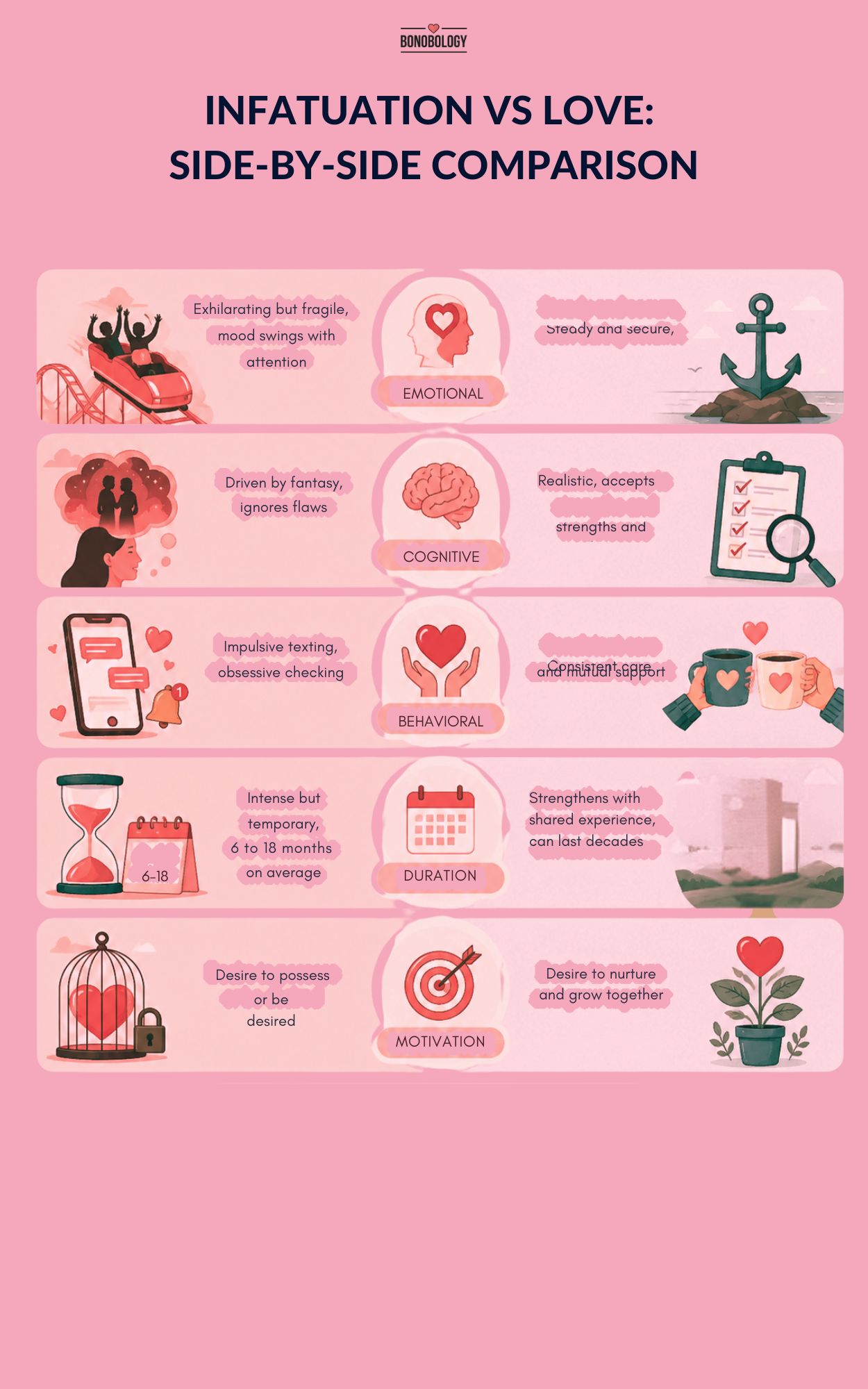
Infatuation vs Love: Side-By-Side Comparison
Seen next to each other, the different types of love and attraction split along fairly predictable lines. Here’s the short version.
How Long Does Infatuation Last?
Infatuation feels endless while you’re in it, but the research tells a different story. According to multiple studies, infatuation typically lasts between 6 and 18 months, occasionally stretching to two years.
When it fades
As novelty wears off and real patterns emerge, dopamine activity drops. The highs level out or disappear. This isn’t failure but biology shifting out of seeking mode and into equilibrium.
Related Reading: How Long Does The Honeymoon Phase Last?
When it evolves into love
If mutual vulnerability, trust, and consistent support build up during this window, infatuation can settle into something more lasting. That tends to happen when both people gradually show their real selves, handle conflict through communication instead of panic, and meet each other’s needs through trust rather than thrill.
“Infatuation is normally short-lived, but it can last anywhere from one month to three years, even in a long-distance relationship. It happens when you don’t yet know someone well enough, so you get smitten with the one side of them you do know. Once you spend more time together and see other dimensions of their personality, the infatuation slowly fades.
“Nandita Rambhia, Psychologist
Infatuation vs limerence: Are they the same thing?
They overlap but aren’t identical. Limerence is a specific psychological term for an involuntary, often obsessive romantic fixation, frequently one-sided, that can tip into checking someone’s social media on a loop or reading meaning into every text. Infatuation is the broader, more common experience; limerence describes its more extreme, intrusive edge. If the preoccupation is starting to interfere with sleep, work, or other relationships, it’s worth reading about how to stop being obsessed with someone, since that crosses from infatuation into something that needs more deliberate handling.
Turning infatuation into a deeper connection
1. Replace fantasy with curiosity. Ask real questions instead of the idealized ones you’ve been asking in your head
2. Build emotional safety. Share what actually worries you, and listen without judgment when they do the same
3. Balance individuality and closeness. Love grows when two whole people keep choosing each other, not when one person fills a gap in the other
4. Be patient. Real connection is built through time, conflict, and trust, not constant excitement
Is It Infatuation, Love, Or Lust?
These three get tangled together because they can show up at the same time. Lust is about physical wanting. Infatuation adds fantasy and idealization on top of that wanting. Love adds trust, acceptance, and time.
A useful way to check yourself: strip away the physical attraction for a moment. Is there still something there? Do you like who they are when nothing romantic is happening, or only when it is? Working through the difference between lust and love can help separate what’s biology from what’s an actual bond.
Related Reading: Take The Lust Vs Love Quiz
Risks And Pitfalls Of Unchecked Infatuation
Infatuation can be genuinely fun, but left unexamined, it gets expensive. Here’s where it tends to go wrong.
1. Obsessive thinking

Infatuation hijacks the brain’s reward system in a way that resembles addiction. Dopamine spikes when you expect contact, and cortisol spikes when you don’t hear from them, which keeps the loop running and can leave you emotionally unstable.
How it shows up
- You replay conversations, hunting for hidden meaning in a word or an emoji
- You refresh their social media repeatedly to check if they’ve seen your message
- Thoughts of them intrude during work, meals, or sleep
- You feel brief relief after their attention, followed by craving the second it pauses.
- You catch yourself planning a future together despite barely knowing them.
Why it happens
Dopamine fires for anticipation, not satisfaction, so the more uncertain or unavailable someone is, the more addictive the chase becomes.
Related Reading: How Long Does A Crush Last, And 14 Ways To Get Over It
2. Emotional distress
Infatuation feels euphoric at its peak and unbearable when it dips, swinging between dopamine highs and cortisol-driven lows.
Typical emotional patterns
- Euphoria when they text or show affection.
- Anxiety when they go quiet, triggering a fear of rejection.
- Self-worth that rises and falls with their attention.
- Racing heart, appetite loss, and trouble sleeping.
- Small misunderstandings that feel catastrophic.
3. Ignoring red flags

Infatuation clouds judgment by idealizing the person instead of seeing them clearly. Protecting the fantasy matters more than facing reality, so warning signs get minimized or explained away.
Common red-flag dismissals
- Incompatibility denial: Telling yourself “we’re just different” instead of naming a real conflict in values
- Boundary erosion: Tolerating disrespect or emotional unavailability to keep the connection alive
- Selective attention: Focusing on the chemistry, ignoring the instability
- Excuse-making: Blaming poor behavior on stress or “a bad day” every single time
- Ignoring intuition: Dismissing a quiet sense of discomfort as overthinking
Psychological root
This comes from idealization bias. Your brain filters information to protect the fantasy, prioritizing reward over an accurate read of the situation.
Related Reading:11 Expert Tips To Stop Being Obsessed With Someone
4. Unhealthy sacrifice
When infatuation takes over, your sense of balance and identity starts to erode. Staying close to this person becomes more important than your own boundaries.
Typical behavioral sacrifices
- Neglecting hobbies: Dropping activities you used to love just to stay available
- Social withdrawal: Seeing less of friends who might question the intensity
- Focus decline: Losing productivity because your attention is elsewhere
- Self-neglect: Disrupted eating and sleep to accommodate their schedule
- Overextension: Excessive gifting or rearranging your life for very little in return
Long-term effect
When the infatuation fades, people are often left feeling empty or resentful, realizing they invested in an illusion rather than mutual growth.
How To Get Over Infatuation In A Healthy Way
Diagnosing infatuation is only useful if you know what to do with it, especially when the feelings aren’t going anywhere good or aren’t being returned.
- Name it for what it is. Once you can say “this is infatuation, not love,” the fog starts to lift. If you’re figuring out how to get over infatuation step by step, this admission is where it starts
- Cut the reinforcement loop. Limit texting, mute their social media, and stop checking for updates. Every bit of contact resets the craving cycle
- Humanize them on purpose. Actively list their less flattering traits to balance out the idealized version in your head. It sounds petty, but it works
- Fill the space with something else. A hobby, a class, or time with friends gives your attention somewhere to go instead of looping back to them. If this started as a crush you’re trying to get over, the same distraction strategy applies
- If it’s one-sided, say so out loud. Naming the unrequited love for what it is, rather than hoping it’ll shift, tends to speed up the healing
- Give it time and don’t rush the ending. Feelings this intense don’t switch off overnight. If you need more structure, a longer guide on how to stop crushing on someone can help you build a week-by-week plan
If the infatuation was inside an actual relationship that’s run its course, the process looks a little different and slower.Falling out of love with someone you’ve built a life with takes more deliberate unwinding than getting over a crush ever does.
Related Reading: How To Love Yourself Again After Getting Your Heart Skinned, 17 Tips
FAQs
No. Most people experience infatuation at some point, and it’s often the first step toward getting to know someone. It only becomes a problem when it turns extreme or you stop seeing the person clearly.
Most research points to six to eighteen months, occasionally stretching toward two years before it fades or shifts into something steadier. In long-distance situations, it can run longer simply because there’s less day-to-day reality to test it against.
Yes, but not automatically. It typically starts with physical or sexual attraction, and that pull is what keeps things going early on. Whether it becomes love depends on whether both people choose to build trust and intimacy once the initial rush fades, and on whether the feelings are mutual at all.
If you’re mostly focused on the physical, feeling desperate, or avoiding anything that might puncture the fantasy, that points to infatuation. Love tends to feel steadier, slower, and more curious about the whole person, not just the highlight reel.
Yes, and it doesn’t automatically mean anything is wrong with your relationship. A new coworker or acquaintance can trigger the same dopamine-driven rush described above without your feelings for your partner changing. What matters is what you do with it, since acting on it is a very different decision than simply noticing it and letting it pass.
Final Thoughts
Infatuation and love can feel nearly identical while you’re inside either one. Love is built to last, infatuation isn’t, and the physical rush of the second one is often mistaken for the depth of the first. Once you know the actual signs of infatuation, from the pedestal-building to the obsessive checking to the fear of showing your real self, it gets a lot easier to name what you’re feeling honestly. Infatuation can turn into love. It just isn’t guaranteed to, and you shouldn’t build your hopes on the assumption that it will.
Your contribution does not constitute a charitable donation. It will allow Bonobology to continue bringing you new and up-to-date information in our pursuit of helping anyone in the world to learn how to do anything.







Featured
Should You Kiss On The First Date? Expert Advice And Practical Tips
Second Date Kiss: Tips And Signals To Look For
How Mutual Respect Influences Relationship Satisfaction
Why Cross-Cultural Relationships Are Growing
Dating While Pregnant: Complete Guide to Healthy, Respectful Connections
Good Rizz Lines For A Girl: Best Flirty, Smooth And Funny Lines That Work
Introvert Dating: A Complete Guide (2026)
The Role of Trust in Relationships: How to Build and Maintain It
5 Communication Styles In Relationships: What They Mean & How To Use Them
21 Nuggets Of Relationship Advice For Women
What Is Simping And Is It A Red Flag In Guys?
Introvert Dating Introvert: A Complete Guide
Is He Shy Or Not Interested? 26 Ways To Tell The Difference
Gen Z Dating: Understanding and Navigating the Landscape
What Are Fun Dating Questions? 140 Playful, Flirty, and Deep Starters
Navigating Exclusivity In A Relationship: How To Do It Right
Do Girls Like Shy Guys? 7 Reasons They Do
101 Fun Date Night Questions To Laugh, Flirt, And Bond Over
161 Weird Questions To Ask Your Boyfriend And Get Him Talking
Why I Will Never Date A Widower Again -A Woman’s Story